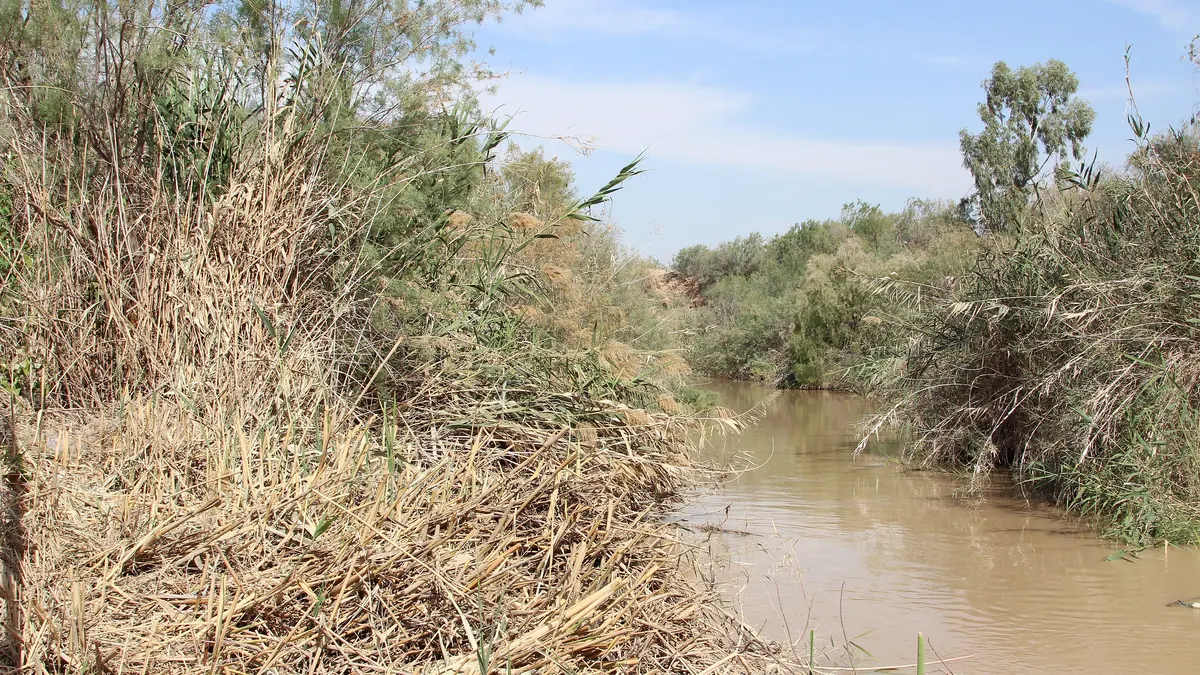
John the Baptist is the one figure whom Christianity, Islam and Mandaeism all honour as a prophet of God, and whom Jewish memory preserves through the historian Josephus. Each tradition tells his story from a different vantage. For Christians he prepares the way for Jesus; for Muslims he is Yaḥyā (يحيى, John), a prophet given wisdom as a child; for Mandaeans he is Yahya Yuhana, the greatest and the last of the prophets, and the teacher whose baptism they still perform.
In the Gospels
The Gospel of Luke opens with his birth: an angel announces to the priest Zechariah that his wife Elizabeth, long childless and advanced in years, will bear a son who is to be called John.1 Mark presents the adult John in the wilderness, proclaiming a baptism of repentance for the forgiveness of sins and baptising crowds in the river Jordan, among them Jesus of Nazareth.2 The Gospels close his life with his arrest and beheading at the order of Herod Antipas, the ruler of Galilee.3
Christian tradition reads him as the forerunner, the voice that prepares the way for the Messiah.
In Jewish memory
John does not appear in the Hebrew Bible, which closes centuries before his birth, and rabbinic literature does not mention him. The fullest Jewish account comes from the historian Josephus, writing near the end of the first century. He describes John as a good man who urged the Jews to practise virtue and justice and to come together in baptism, and he records that Herod Antipas, fearing John’s hold on the crowds, imprisoned him at the fortress of Machaerus, east of the Dead Sea, and put him to death there.4
In the Qur’an
The Qur’an tells of Zakariyyā (زكريا, Zechariah) praying in old age for an heir and receiving the promise of a son named Yaḥyā, of whom God says that He had made no samiyy (سمي) for him before.5 The classical exegetes read the word two ways. Taken as a namesake, it means that no one before him had borne the name; taken as a peer, it means that no one before had been like him. Mujāhid and Saʿīd ibn Jubayr explained it as one like him, and Ibn ʿAbbās added that no barren woman had ever borne such a child. Al-Ṭabarī reported both readings and preferred the first.6 On either reading the name is distinct. Yaḥyā is formed from the Arabic root of life, while John renders the Hebrew Yoḥanan, which joins the divine name to a root meaning grace: two names from two different roots.7 The son is to confirm a word from God and to be honourable, chaste, and a prophet among the righteous.8 He is commanded to hold fast to the scripture and is given wisdom while still a child, together with tenderness, purity and devotion to his parents; peace is upon him on the day of his birth, the day of his death and the day he is raised alive.9
Islamic tradition therefore counts Yaḥyā among the prophets and pairs him with his cousin ʿĪsā (عيسى, Jesus), whose own birth the Qur’an narrates in the verses that follow.
In Mandaean tradition
Mandaeans call him Yahya Yuhana, keeping both names side by side, and they value the first for its meaning, “he lives”.10 A legend told among them recounts that he was born to the aged Zakharia and his wife ʿInoshwey, carried away as an infant by a being of light and nursed in a heavenly world, and consecrated a priest at twenty-one before being sent to Jerusalem as a prophet.11
The community’s own history scroll describes his ministry in its own terms. Yahya Yuhana, it says, took the yardna and the water of life, cleansed lepers, opened the eyes of the blind and made the maimed walk; he taught disciples and proclaimed the call of the Life for forty-two years before he was taken up.12 Mandaeans trace their religion to Adam and honour John as its greatest teacher, and every baptism in running water repeats the rite they hold he practised.
One figure, four readings
The four traditions agree on the outline: a prophet of the Jordan, born to an aged priest and his wife, who called his hearers to repentance and baptised them in running water, and who died at the hands of a ruler he had offended. They differ on what his life meant. The Gospels subordinate him to Jesus, the Qur’an honours him as a prophet in his own right, Josephus remembers a moral teacher, and the Mandaeans keep him as the last and greatest of the messengers. See also Masbuta: baptism in running water and Mandaeism.
Further reading: The Sabians of the Qur’an and Understanding the Bible and the Qur’an in historical context, Jesus across the traditions and Mary across the traditions.

Notes
- Luke 1:5-25, 57-66. ↩
- Mark 1:4-9. ↩
- Mark 6:17-29. ↩
- Josephus, Antiquities 18.116-119. ↩
- Qur’an 19:2-7. ↩
- “And No One Had The Name Yaḥya (= John?) Before: A Linguistic & Exegetical Enquiry Into Qur’an 19:7”, Islamic Awareness, first composed 8 July 2000, last updated 18 August 2000, section 6, citing the commentaries of Ibn Kathīr and al-Suyūṭī on Qur’an 19:7; cf. Qur’an 19:65, the only other occurrence of samiyy. ↩
- Ibid., sections 2, 3 and 7. ↩
- Qur’an 3:39. ↩
- Qur’an 19:12-15. ↩
- E. S. Drower, The Mandaeans of Iraq and Iran (Oxford: Clarendon Press, 1937), p. 281. ↩
- Ibid., pp. 261-262. ↩
- E. S. Drower, ed. and tr., The Haran Gawaita and the Baptism of Hibil-Ziwa (Vatican City: Biblioteca Apostolica Vaticana, 1953), p. 7. ↩