Judaism is the religion of the Jewish people, rooted in the covenant that the Hebrew Bible describes between God and the descendants of Abraham, Isaac and Jacob. It is the oldest of the three great monotheistic traditions of the Near East, and the ground from which Christianity and Islam later grew. Close to sixteen million Jews live worldwide, most of them in Israel and the United States.
In this article
Judaism: origins and covenant
Jewish tradition traces its beginnings to Abraham, who in the biblical account leaves his homeland at God’s call, and to the covenant renewed with Moses at Mount Sinai after the exodus from Egypt. The ancient Israelites formed kingdoms in the land of Canaan, built the First Temple in Jerusalem, and experienced exile in Babylon after the Temple’s destruction in 586 BCE. A Second Temple stood from 516 BCE until the Romans destroyed it in 70 CE.
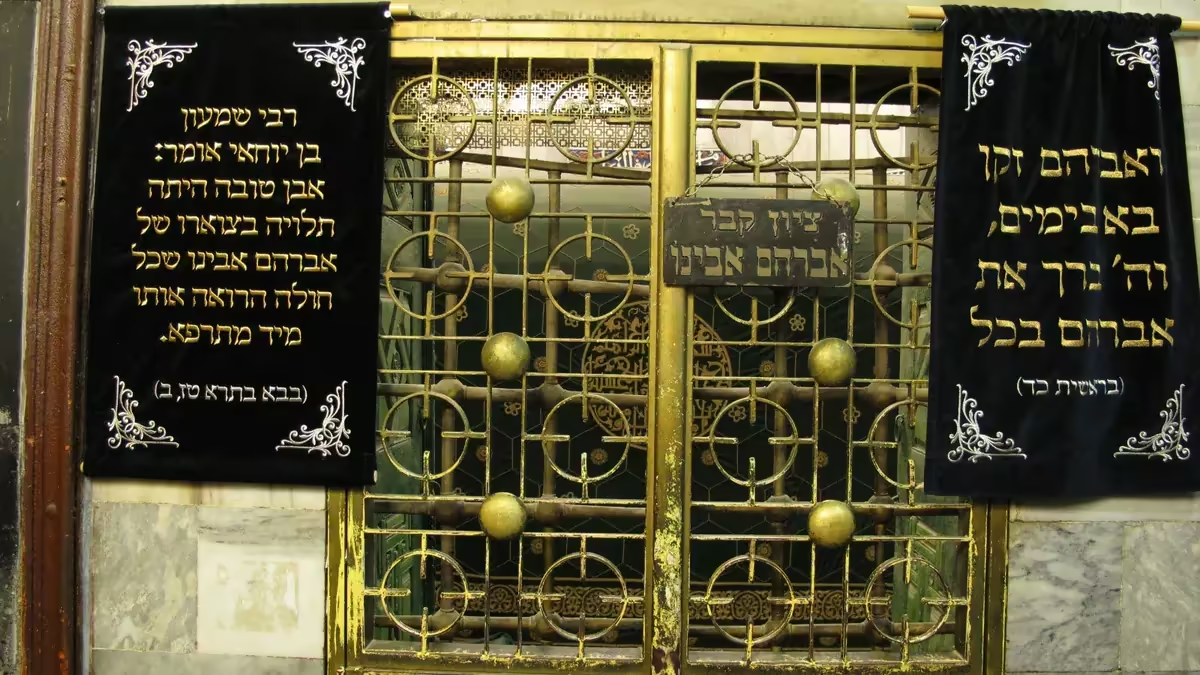
Judaism gave the world its first sustained account of one God. The Shema (שמע, “hear”), recited morning and evening, opens with the declaration that the Lord is one.1 Later Jewish teaching read the formula naming the God of Abraham, Isaac and Jacob as pointing to three qualities revealed in turn: steadfast love, awe, and the search for truth.2 Jewish teaching holds that God’s care extends to all people, and that the covenant with Israel lays a charge on those within it: the community is to live in a way that makes God’s justice visible.
Belief and conduct
Judaism has no binding creed. Conduct carries the weight that doctrine carries elsewhere, and considerable latitude remains in matters of belief, including the messianic future and life after death. Maimonides set out thirteen principles in the twelfth century, and they are widely honoured without functioning as a test of membership.
Scripture and interpretation
The Hebrew Bible, or Tanakh (תנ״ך, from the initials of its three parts), comprises the Torah (תורה, “instruction”), the five books of Moses; the Nevi’im (נביאים, Prophets); and the Ketuvim (כתובים, Writings). The Torah holds the highest place and is read in full in the synagogue over the course of each year.
Alongside the written Torah, Jewish teaching recognises an oral Torah, clarified and expanded in the study houses and written down in the Mishnah (משנה, “repetition”) around 200 CE and in the two Talmuds (תלמוד, “study”), completed between the fifth and seventh centuries and composed largely in Aramaic.
Practice and the calendar
Jewish life is shaped by halakhah (הלכה, “the way of walking”), the body of religious law, and by a calendar of sacred time.
- Shabbat (שבת, rest), the weekly day of rest from Friday evening to Saturday evening.
- Kashrut (כשרות, fitness), the dietary laws.
- Prayer three times a day, with the Shema at its heart, and the Kaddish (קדיש, “holy”), a prayer largely in Aramaic that closes sections of the service and is recited by mourners.
- Festivals including Passover, Shavuot, Sukkot, Rosh Hashanah, Yom Kippur, Hanukkah and Purim.
- Life-cycle rites including the circumcision of a boy on the eighth day, and the Bar Mitzvah and Bat Mitzvah at the age of responsibility for the commandments.
The Jewish calendar counts lunar months and keeps pace with the solar year by adding a thirteenth month seven times in each nineteen-year cycle. Days run from sunset to sunset. At morning prayer many observant Jews wear tefillin (תפילין, phylacteries), and a mezuzah (מזוזה, doorpost) holding passages of the Torah marks the doorways of a Jewish home.
Jewish life today
Judaism is a civilisation as much as a religion, carried by communities with distinct languages and customs: Ashkenazi Jews of central and eastern Europe, Sephardi Jews of Spain, Portugal and the lands of their exile, and Mizrahi Jews of the Middle East and North Africa. Religious life today spans Orthodox, Conservative, Reform and Reconstructionist movements, alongside many Jews who hold to the tradition culturally more than religiously.
Continue with Sacred texts, Figures or the Glossary.
Notes
- Deuteronomy 6:4. ↩
- Jacob Agus, on Judaism, in Ismaʿil Raji al Faruqi, ed., and David E. Sopher, map ed., Historical Atlas of the Religions of the World (New York: Macmillan, 1974), p. 140. ↩