Three times the Qur’an names a community called the Ṣābiʾūn (الصابئون, the Sabians), each time beside the Jews and the Christians.1 It never says who they were. Muslim scholars have asked the question since the first centuries of Islam, and the answers they gave show how the Qur’an’s recognition of other communities was read, extended and applied.2

The three verses
Two of the verses promise that those who believe, the Jews, the Christians and the Sabians, whoever of them believes in God and the Last Day and does good, will have their reward with their Lord and will neither fear nor grieve. The third lists the Sabians with the Jews, the Christians, the Magians and the polytheists, and declares that God will judge between them on the Day of Resurrection.3 In the first two the Sabians stand between the Jews and the Christians, a placing that suggests kinship with the People of the Book; the third sets them in a wider company.4
What the exegetes said
The word itself was understood to mean those who turn from one religion to another.5 Al-Ṭabarī (d. 923) gathered the reports that had reached him: the Sabians were a sect of the Christians, or a people between Judaism and Christianity, or worshippers of angels.6 A report from Ibn ʿAbbās places them between the Jews and the Christians, without a scripture of their own.7 Fakhr al-Dīn al-Rāzī (d. 1209) set out the range of views and concluded that none could be chosen decisively, while Ibn Kathīr (d. 1373) counted them a faction of the People of the Book who read the Psalms.8
The exegetes recorded the evidence, weighed it, and left the question open where the text itself left it open.
The jurists
The question mattered in law, because the People of the Book held a protected status. Abū Ḥanīfa is reported to have counted the Sabians among them; Shāfiʿī and Ḥanbalī jurists were more cautious and asked for evidence of a scripture.9 Al-Shahrastānī found a middle term and called them the people of a doubtful book, holders of sacred scrolls whose status was uncertain.10 In practice Muslim rulers extended protection to the communities that claimed the name.11
Two claimants to the name
Two communities took the name under Muslim rule. Reports tell that when the caliph al-Maʾmūn (r. 813 to 833) passed through Harran, in upper Mesopotamia, its people declared themselves Sabians, and they kept their ancient astral worship under that title.12 Al-Bīrūnī, among the earliest Muslim scholars of comparative religion, refused them the name. The Harranians, he wrote, were idolaters who had adopted it to gain protected status; the true Sabians were monotheists, the descendants of Jews who had remained in Babylonia, who revered light, prayed facing the north, and treated the bodies of the dead as a source of pollution.13
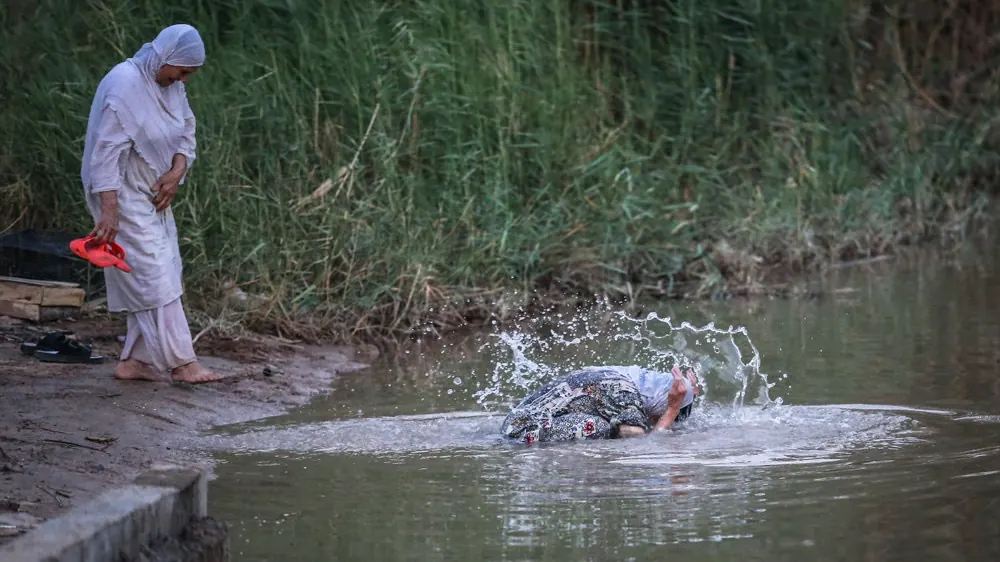
Those marks are recognisable in the Mandaeans of southern Iraq, a monotheist community whose faith centres on the World of Light and whose priests pray facing the North Star.14 Their own history scroll records how their leader, Anush son of Danqa, came before the Arab ruler and explained their faith, and how the Muslims were forbidden to harm them.15The Mandaeans survived, and they are now often regarded as the last living Sabians.16
What the question shows
Modern scholars read the history of the name as a sign of flexibility: the Sabian category allowed Muslim law and theology to bring minority communities within the framework of the People of the Book.17 The Qur’an named a community it did not define, and Muslim scholarship answered with a recognition broad enough to protect those who sought it. A small baptist people from the marshes of Mesopotamia owes much of its survival across fourteen centuries to that recognition. See Mandaeism and Masbuta: baptism in running water.
Further reading: John the Baptist in four traditions and Interfaith dialogue in the modern era, The preservation and transmission of scripture and The Amman Message and A Common Word.

Notes
- Qur’an 2:62; 5:69; 22:17. ↩
- Noor Mohammad Osmani and Abul Kalam Md Motiur Rahman, “The Sabians (al-Ṣābiʾūn): Origins, History, and Religious Identity”, e-ISSN 2600-8394, vol. 9, no. 2 (December 2025), p. 3. ↩
- Qur’an 2:62; 5:69; 22:17. ↩
- Osmani and Rahman, op. cit., p. 5. ↩
- Muhammad Azizan Sabjan, “The Al-Ṣābiʾūn (The Sabians): An Overview from the Quranic Commentators, Theologians and Jurists”, World Journal of Islamic History and Civilization 1, no. 3 (2011), p. 163. ↩
- Osmani and Rahman, op. cit., p. 5. ↩
- Ibid., p. 8. ↩
- Ibid., p. 7. ↩
- Ibid., p. 8. ↩
- Sabjan, op. cit., p. 165. ↩
- Osmani and Rahman, op. cit., p. 8. ↩
- Ibid., p. 9. ↩
- Sabjan, op. cit., p. 165. ↩
- E. S. Drower, The Mandaeans of Iraq and Iran (Oxford: Clarendon Press, 1937), p. 110. ↩
- E. S. Drower, ed. and tr., The Haran Gawaita and the Baptism of Hibil-Ziwa (Vatican City: Biblioteca Apostolica Vaticana, 1953), pp. 15-16. ↩
- Osmani and Rahman, op. cit., p. 2. ↩
- Ibid., p. 1. ↩