Many figures appear in more than one Abrahamic scripture, often with different emphases. The overviews below note how each tradition remembers them.
In this article
Figures: adam
The first human being in all four traditions. Genesis tells of his creation and his expulsion from the garden; Christian theology reads his disobedience as the origin of sin. The Qur’an names Ādam the first prophet and the one to whom God taught the names of all things. Mandaean teaching holds that the first revelation was given to Adam, and it speaks of Adam Kasia, the hidden Adam, the heavenly counterpart of every human soul.
Seth
The third son of Adam and Eve, born after the death of Abel. Jewish and Christian tradition trace the line of the righteous through him, and Muslim tradition counts Shīth among the early prophets. For Mandaeans he is Shitil, the purest of human souls: after death each soul is weighed in the scales of Abathur against the soul of Shitil.1
Noah
The righteous man saved with his family from the flood. The Hebrew Bible makes him the bearer of a covenant with all humankind; the New Testament calls him a preacher of righteousness; the Qur’an gives a sūrah his name, Nūḥ, and presents him as a messenger rejected by his people. Mandaean tradition keeps Noah and his son Shem in its line of prophets, and among the prayers the priests recite at the ritual meal is one that bears the name of Shem son of Noah.2
Abraham
The patriarch whose call and covenant begin the story of Israel in the Hebrew Bible. Christians honour him as a model of faith; Muslims revere Ibrāhīm as a prophet, a ḥanīf (حنيف, pure monotheist) and the friend of God, and the Qur’an commands Muhammad to follow his path.3 Mandaean teaching does not count him among the prophets, and some of its texts describe him as a former priest of the community who broke away from it.
Sarah
Abraham‘s wife and the mother of Isaac. The Hebrew Bible counts her among the matriarchs of Israel; the Qur’an alludes to her when angels bring the news of Isaac’s birth.
Hagar
Sarah’s servant and the mother of Ishmael. Her search for water in the desert is commemorated in the saʿy (سعي, ritual walk) of the Muslim pilgrimage.
Isaac
Abraham’s son with Sarah and the father of Jacob. Jewish tradition remembers the near-sacrifice of Isaac, the Akedah; the Qur’an names Isḥāq as a prophet.
Ishmael
Abraham’s son with Hagar. Islamic tradition regards Ismāʿīl as a prophet who, with his father, raised the foundations of the Kaaba, and as an ancestor of the northern Arab tribes.
Jacob
Isaac’s son, renamed Israel, and the father of the twelve tribes. The Qur’an names Yaʿqūb among the prophets.
Joseph
Jacob’s son, sold into slavery and raised to high office in Egypt. His story fills the last chapters of Genesis and a complete sūrah of the Qur’an. The Qur’an calls the ruler he served al-malik (الملك, the king) and keeps the title Firʿawn (فرعون, Pharaoh) for the ruler of Moses’ day, a distinction that matches the Egyptian record.4 See The king and the Pharaoh.
Moses
The prophet who led the Israelites out of Egypt and received the Torah at Sinai. Mūsā is the prophet named most often in the Qur’an. Mandaean teaching does not accept him as a prophet.

David
The shepherd who became king of Israel and, by tradition, the author of many psalms. Muslims honour Dāwūd as a prophet who received the Zabūr (زبور, the Psalms).
Solomon
David’s son, remembered for his wisdom and for building the First Temple. In the Qur’an, Sulaymān is a prophet-king granted command over the wind and the jinn.
Mary
The mother of Jesus. Christians honour her as the mother of God’s Son; Maryam is the only woman the Qur’an mentions by name, and a sūrah bears her name. See Mary across the traditions.
John the Baptist
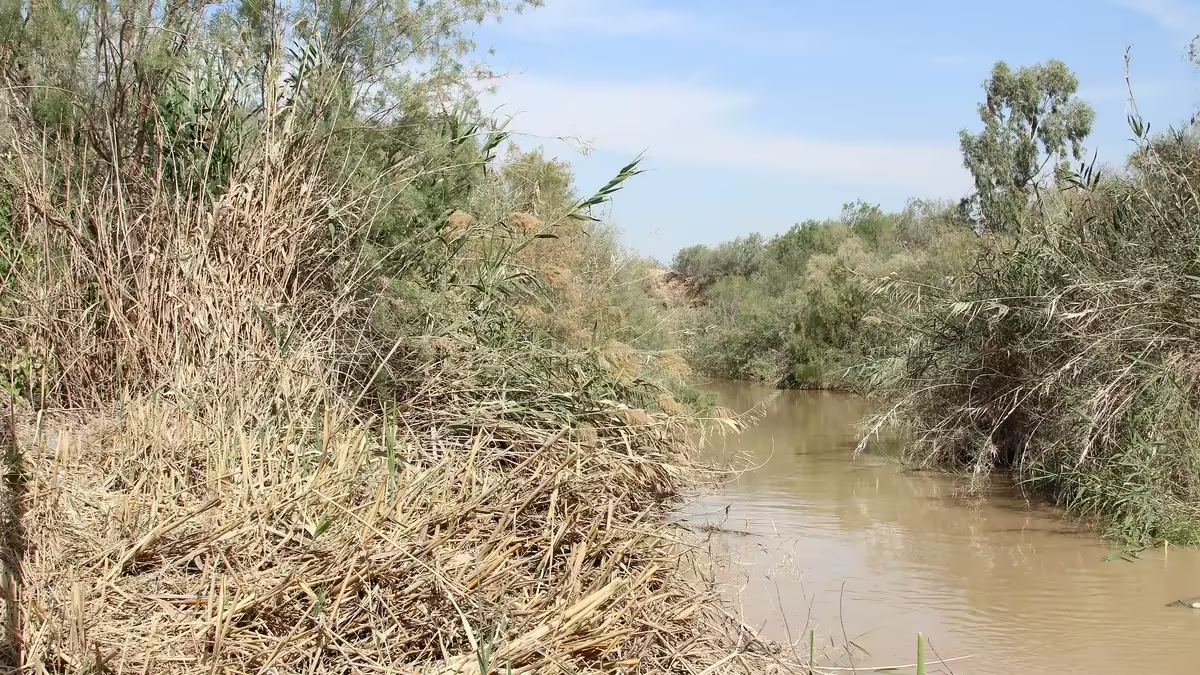
A preacher of repentance who baptised in the Jordan. The Gospels present him as the forerunner of Jesus; the Qur’an names him Yaḥyā and calls him confirmed in wisdom; Mandaeans hold him to be the greatest and the last of the prophets, and their rites of baptism look back to him.
Jesus
For Christians, Jesus of Nazareth is the Messiah, the Son of God, crucified and raised from the dead. Muslims honour ʿĪsā as the Messiah and one of the greatest prophets, born of the Virgin Mary, and do not regard him as divine. Jewish tradition does not accept him as the Messiah. Mandaean texts remember him as a pupil of John who altered what John had taught. See Jesus across the traditions.
Muhammad
The Prophet of Islam, born in Makkah (Mecca) around 570 CE. Muslims regard him as the final messenger of God, through whom the Qur’an was revealed. Mandaeans do not accept him as a prophet; under Muslim rule their community was recognised as the Sabians whom the Qur’an names beside the Jews and the Christians.
Notes
- E. S. Drower, The Mandaeans of Iraq and Iran (Oxford: Clarendon Press, 1937), pp. 197-199. ↩
- Ibid., p. 163. ↩
- Qur’an 16:123. ↩
- Qur’an 12:43, 12:50, 12:54, 12:72, 12:76; 7:104; 10:75. On the Egyptian usage, I. Shaw and P. Nicholson, British Museum Dictionary of Ancient Egypt (London: British Museum Press, 1995), p. 222. ↩