Islam, (إسلام, “submission” to God), is the religion of Muslims, who hold that God revealed the Qur’an to the Prophet Muhammad in the seventh century CE as the final message in a line of prophets that includes Abraham, Moses and Jesus. Close to two billion people profess it, which makes it the second-largest religion in the world and the fastest-growing.
In this article
The meaning of the word
The Arabic word carries more than its usual English renderings of submission or surrender suggest. It names a commitment made to God without reservation, joining trust, obedience and peace in a single term. The Qur’an speaks of the religion of Abraham, and Muslims understand Islam as the restoration of that original monotheism, given again through a final messenger.
The Prophet and the first community
Muhammad was born in Makkah (Mecca) around 570 CE. Muslims hold that revelation began around 610, when he was about forty, and continued for some twenty-three years. Makkah at that time was governed by a balance between clans, with four months of each year set aside in which no hostility was tolerated and the caravan routes were safe.
At the centre of the city stood the sanctuary, holding the Kaaba, which Muslim tradition holds Abraham and Ishmael built for the worship of the one God, and which by then housed some three hundred idols.1 His preaching of one God met resistance in that city, and in 622 he and his followers migrated to Madinah (Medina), an event called the hijrah (هجرة, migration), which begins the Islamic calendar. By his death in 632, most of the tribes of Arabia had accepted Islam.
Expansion and the caliphate
After the Prophet’s death the community chose Abu Bakr as caliph. Under his successors, and then the Umayyad and Abbasid dynasties, Muslim rule reached from Spain to Central Asia within a century. Baghdad under the Abbasids became a centre of learning where Greek, Persian and Indian works were translated and extended. Islam reached West Africa through trade and teaching from the tenth century, and the Malay archipelago from the thirteenth, where Indonesia now holds the largest Muslim population of any country.
Scripture and tradition
The Qur’an (قرآن, “recitation”) contains 114 chapters. Muslims regard it as the literal speech of God in Arabic, preserved in writing and in the memory of reciters in every generation. Alongside it stands the sunnah (سنة, “custom”), the example of the Prophet, known through reports called ḥadīth (حديث, “report”). From these sources scholars developed Qur’anic exegesis and fiqh (فقه, “understanding”), the jurisprudence expressed in the Hanafi, Maliki, Shafi’i and Hanbali schools.
Islam among the religions
Asked about its own origins, Islam names as its predecessor the way of the ḥunafāʾ (حنفاء, those who turned to God alone), and the Qur’an identifies the two.2 Parallels with Jewish and Christian teaching are numerous, and on this account they establish neither borrowing nor descent: both religions were known in Arabia and treated as foreign, while the ḥanīf was an Arab among Arabs.3
Muslim thought has a settled account of where the other religions stand. True religion, on this reading, is what acknowledges God as Lord and Creator and directs a person to a life of moral worth; it is natural to human beings, freely held, and no burden to carry.4 The Qur’an describes it as the pattern on which God made humankind, and calls the one who turns to it ḥanīf (حنيف, pure monotheist).5
Reason alone can reach that religion, and God has nevertheless sent prophets to every people, because people forget and fall away, which makes the message necessary again and again. The core of each revelation was one and the same, while the law attached to it developed with the times. On this account Judaism and Christianity began as divine religions and later departed from what had been given them, which is why the message required restating.6
Muslim writers place Muhammad at the close of that sequence. The Qur’an describes him as a man like other men, without supernatural power, unable to save or to condemn, or even to intercede at will, since all power belongs to God. The miracle, in this account, lies in the content of what was revealed and not in any transformation of the man who carried it.7
The five pillars
- Shahādah (شهادة, testimony): the declaration that there is no god but God and that Muhammad is God’s messenger.
- Ṣalāh (صلاة, ritual prayer): prayer five times a day, facing Makkah.
- Zakāh (زكاة, purifying alms): an annual payment to those in need.
- Ṣawm (صوم, fasting): the fast of the month of Ramadan.
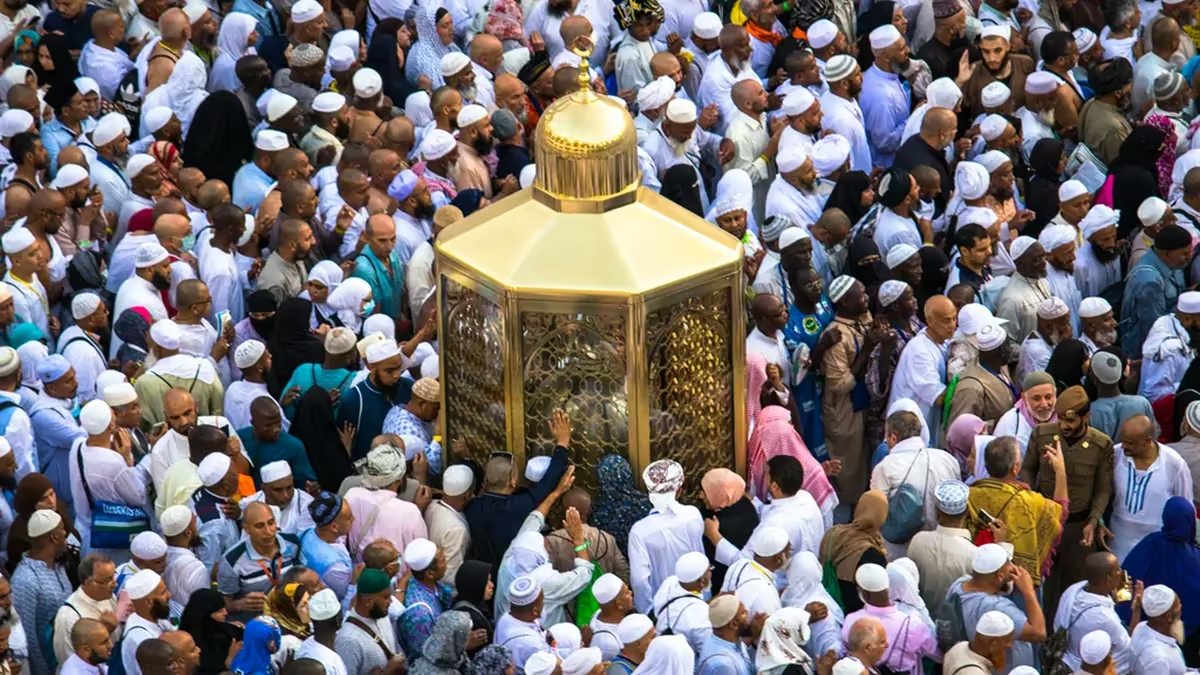
- Ḥajj (حج, pilgrimage): the pilgrimage to Makkah, once in a lifetime for those able.
Prophets before Muhammad
The Qur’an teaches that God has sent messengers to every people, and it names many figures known from the Hebrew Bible and the Gospels, among them Abraham, Moses, David, Solomon and Jesus. Muslims therefore describe those who submitted to God before Muhammad as Muslims in the root sense of the word, and recognise a particular kinship with Jews and Christians as heirs of Abraham.8
Continue with Sacred texts, Places or the Glossary.
Notes
- Ismaʿil Raji al Faruqi, ed., and David E. Sopher, map ed., Historical Atlas of the Religions of the World (New York: Macmillan, 1974), p. 240. ↩
- Ibid., p. 237. ↩
- Ibid. ↩
- Ismaʿil Raji al Faruqi, in Wing-tsit Chan, Ismaʿil Raji al Faruqi, Joseph M. Kitagawa and P. T. Raju, comps., The Great Asian Religions: An Anthology (New York: Macmillan, 1969), p. 323. ↩
- Qur’an 30:30; 4:125. ↩
- The Great Asian Religions, p. 323. ↩
- Ibid., p. 332. ↩
- Qur’an 2:136; 29:46. ↩