This timeline outlines the main periods in the history of Judaism, Mandaeism, Christianity and Islam. Dates before the first millennium BCE rest largely on tradition and are approximate.
In this article
- The timeline: ancient Near East (c. 2000 to 1200 BCE)
- The Israelite kingdoms (c. 1000 to 586 BCE)
- The Second Temple period (516 BCE to 70 CE)
- Jesus and the early church (c. 4 BCE to 313 CE)
- Rabbinic Judaism and the Christian empire (70 to c. 600 CE)
- The rise of Islam (610 to 750 CE)
- The medieval world (750 to 1500)
- The early modern era (1500 to 1800)
- The modern era (1800 to the present)
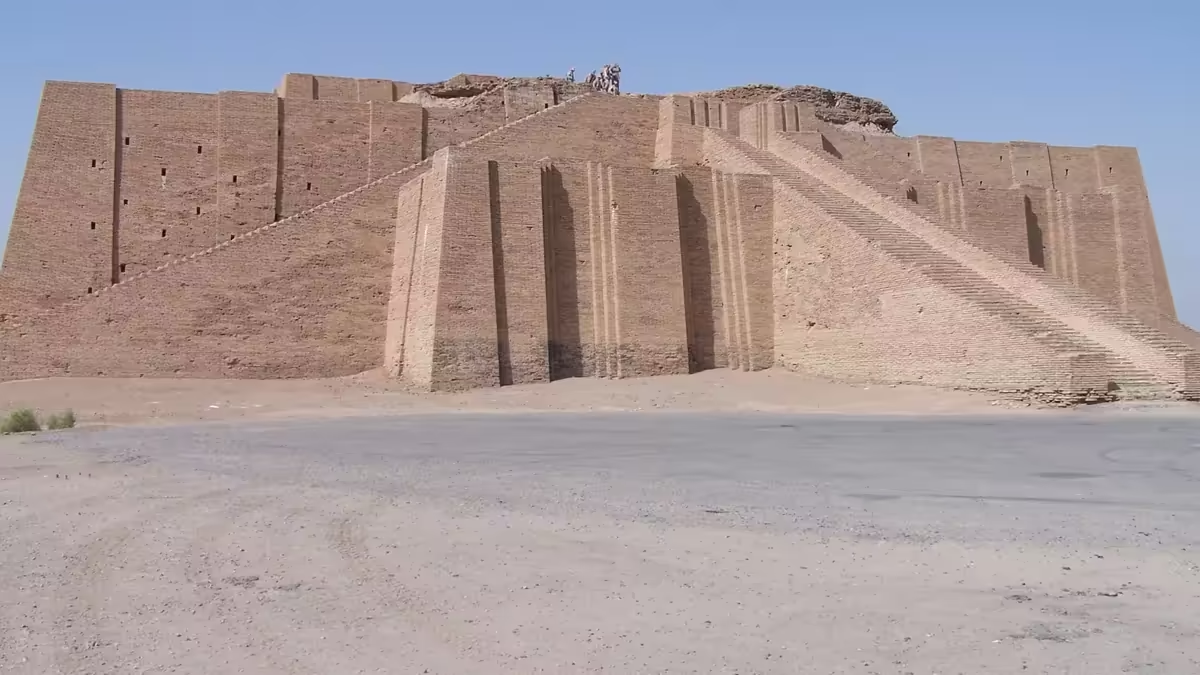
The timeline: ancient Near East (c. 2000 to 1200 BCE)
The biblical narratives of Abraham, Isaac and Jacob are set in this period, although no source outside scripture names them. The Merneptah Stele of about 1208 BCE contains the earliest known reference to a people called Israel.
The Israelite kingdoms (c. 1000 to 586 BCE)
According to the Hebrew Bible, David made Jerusalem his capital and Solomon built the First Temple. The kingdom later divided into Israel in the north, conquered by Assyria in 722 BCE, and Judah in the south, conquered by Babylon in 586 BCE, when the Temple was destroyed and many were taken into exile.
The Second Temple period (516 BCE to 70 CE)
Exiles returned under Persian rule and completed the Second Temple in 516 BCE. The region later came under Greek and then Roman control. Judaism in this period was diverse, and many of the writings found among the Dead Sea Scrolls date from it. The Romans destroyed the Temple in 70 CE.
Jesus and the early church (c. 4 BCE to 313 CE)
Jesus of Nazareth taught in Galilee and Judea and was crucified in Jerusalem around 30 CE. His followers spread their message across the Roman Empire, where Christians faced periods of persecution. The New Testament writings date from the first century and the early second century.
In the same centuries, by the account the Mandaeans keep in their own scroll, their forebears left Jerusalem for the Median hills under a Parthian king. The colophons of their scriptures carry an unbroken chain of copyists back to the second or third century.
Rabbinic Judaism and the Christian empire (70 to c. 600 CE)
After 70 CE, rabbinic sages reshaped Jewish life around study, prayer and law, producing the Mishnah and the Talmuds. The Edict of Milan in 313 granted Christians freedom of worship, and in 380 Christianity became the official religion of the Roman Empire. Church councils defined core Christian doctrine.
The rise of Islam (610 to 750 CE)
Muslims date the first revelation to Muhammad to about 610. The hijrah to Madinah (Medina) in 622 begins the Islamic calendar. After the Prophet’s death in 632, the Rashidun caliphs (632 to 661) and the Umayyad dynasty (661 to 750) ruled a state that stretched from Spain to Central Asia. Jews and Christians under the new rule kept their worship and their communal courts as protected peoples, and the Mandaeans of southern Iraq were recognised as the Sabians of the Qur’an, and so as a people of the book.
The medieval world (750 to 1500)
Under the Abbasid caliphs, Baghdad became a centre of learning until its fall to the Mongols in 1258. Jewish, Christian and Muslim philosophers exchanged ideas, often through translation. The Crusades, launched in 1095, brought a century of Latin rule to Jerusalem. In 1453 the Ottomans took Constantinople, and in 1492 the Catholic monarchs completed their conquest of Granada and expelled Spain’s Jews.
The early modern era (1500 to 1800)
The Protestant Reformation, beginning in 1517, divided Western Christianity. The Ottoman Empire ruled Jerusalem from 1517 and much of the Muslim Middle East for four centuries. Jewish communities flourished and suffered in turn across Europe and the Ottoman lands.
The modern era (1800 to the present)
The modern period brought new religious movements, colonial rule and its end, and mass migration. During the Holocaust, Nazi Germany and its collaborators murdered some six million Jews. The State of Israel was established in 1948, and the war that followed displaced a large Palestinian Arab population. The Second Vatican Council (1962 to 1965) reshaped Catholic relations with Jews and Muslims, and organised interfaith dialogue grew worldwide. The violence that followed 2003 drove most Mandaeans from Iraq, and the community now lives chiefly in diaspora.
For a closer look at single periods, see the Journal section.
See also: Judaism (Encyclopaedia Britannica).