Christianity is the religion centred on the life, teaching, death and resurrection of Jesus of Nazareth, whom Christians confess as the Messiah and the Son of God. With about 2.4 billion adherents, it is the largest religious tradition in the world, and its divisions into Catholic, Orthodox and Protestant churches have shaped much of its history.
In this article
Christianity: origins
Christianity began in the first century CE among Jewish followers of Jesus in Judea and Galilee. The Gospel of Matthew carries two traditions about how far the message was to travel: one confines the twelve to Jewish territory, while the other sends them, after the resurrection, to the ends of the earth.1
The account in Acts follows the second, beginning in Jerusalem and moving outwards through Samaria. After his crucifixion under the Roman governor Pontius Pilate, his followers proclaimed that God had raised him from the dead. Missionaries, among them the apostle Paul, carried the message across the eastern Mediterranean, and communities of non-Jewish believers soon outnumbered the Jewish ones. The Christian Bible joins the Hebrew scriptures, called the Old Testament, with the New Testament.
Belief
The early church defined its central doctrines at councils. The Council of Nicaea in 325 and the Council of Constantinople in 381 affirmed the doctrine of the Trinity: one God in three persons, Father, Son and Holy Spirit. The Council of Chalcedon in 451 affirmed that Jesus is one person with a divine and a human nature. These definitions remain the common inheritance of the churches described below, whatever else divides them.
The Catholic Church
The Catholic Church counts about 1.4 billion members, the largest body of Christians. It traces its ministry to the apostles, with the Bishop of Rome as the successor of Peter. Catholic life turns on seven sacraments: baptism, confirmation, the Eucharist, penance, anointing of the sick, holy orders and matrimony. The Mass stands at the centre of worship, and the saints are honoured as examples and intercessors.
The Orthodox churches
The Eastern Orthodox churches trace their separation from Rome to a long estrangement that hardened in 1054. Each national church governs itself while sharing one faith and liturgy, and together they hold to the practice of the early church with particular care: iconography, chant and a liturgy of great length and antiquity. The Oriental Orthodox churches and the Church of the East separated earlier, over the Christological definitions of the fifth century.
The Protestant churches
The Protestant movement began in the sixteenth century as a call to reform what its leaders regarded as corruption in the Western church. Two principles shaped it: scripture as the supreme authority, and salvation received through faith. From it came the Lutheran, Reformed, Anglican, Baptist, Methodist and later Pentecostal traditions, which today form the fastest-growing part of Christianity in Africa, Asia and Latin America.
Worship and practice
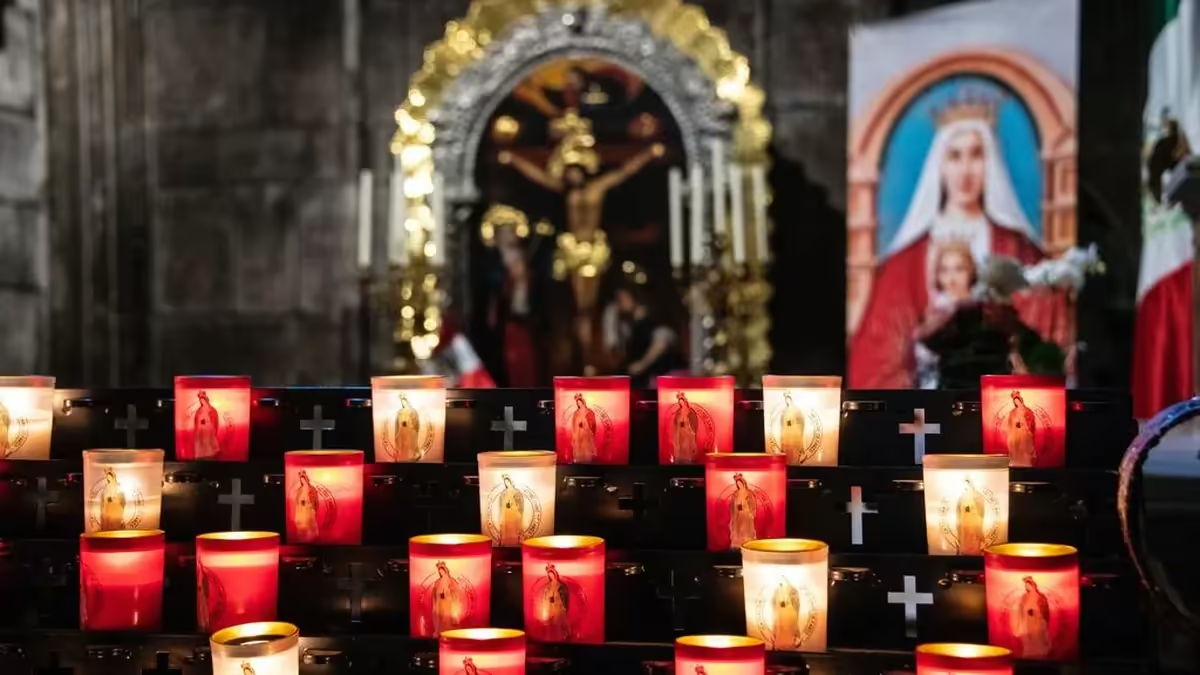
Baptism and the Eucharist, the shared bread and wine that recall the Last Supper, are common to nearly all churches. The great festivals are Christmas and Easter, and the Lord’s Prayer, which the Gospels record Jesus teaching his disciples, is said in every tradition.2
Continue with Sacred texts, Comparative studies or the Glossary.
Notes
- Gerard Sloyan, on Christianity, in Ismaʿil Raji al Faruqi, ed., and David E. Sopher, map ed., Historical Atlas of the Religions of the World (New York: Macmillan, 1974), p. 201; Matthew 10:5-6; 28:19. ↩
- Matthew 6:9-13; Luke 11:2-4. ↩