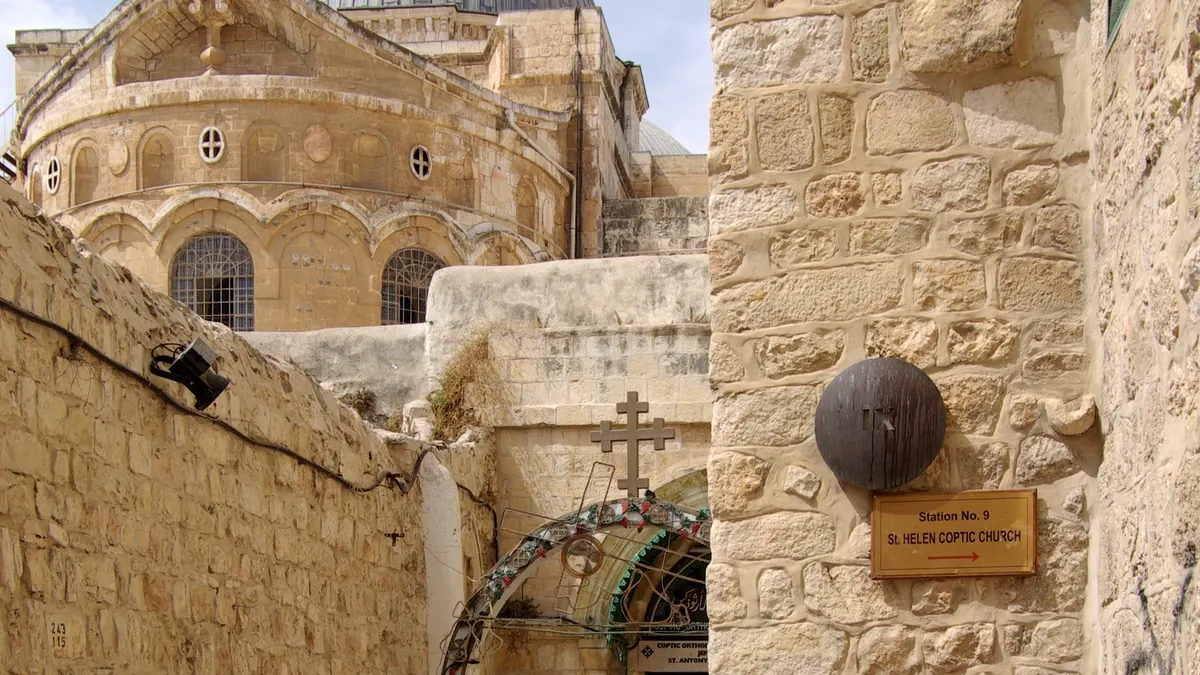
Jesus is honoured across three of the four Abrahamic traditions, though each gives him a different place. For Christians he is Lord and Saviour; for Muslims he is ʿĪsā (عيسى), a prophet and the Messiah, born of a virgin but not divine; Jewish tradition does not accept him as the Messiah it awaits. Mandaean texts remember him as a pupil of John who altered what John had taught.
In this article
In the Gospels
Matthew and Luke open with his birth to Mary, a virgin betrothed to Joseph, in Bethlehem.1 The Gospels present him teaching, healing and gathering disciples in Galilee and Judea, and record his trial before Pontius Pilate and his crucifixion outside Jerusalem, followed by his resurrection on the third day.2 Christian doctrine, formulated at the councils of Nicaea and Chalcedon, holds him to be the second person of the Trinity, fully God and fully man.3
In Jewish tradition
Judaism does not recognise Jesus as the Messiah, whose coming it holds is still awaited, and rejects the claim of his divinity as incompatible with the strict monotheism of the Shema. Jewish scholarship generally situates him as a first-century Jewish teacher whose followers, after his death, became a movement distinct from the Judaism of his day.
In the Qur’an
The Qur’an devotes a chapter to his mother and tells of his birth to Maryam, a virgin, by the command of God, without a father.4 It calls him al-Masīḥ (المسيح, the Messiah) and Kalimat Allāh (كلمة الله, a word from God), a prophet who spoke from the cradle and worked miracles by God’s permission.5
It denies that God has a son, denies the crucifixion, and states that God raised him to Himself: “they did not kill him, nor did they crucify him, but it was made to appear so to them.”6 Classical exegetes disagree on the exact mechanism of the substitution and on whether Jesus died a natural death after being raised, but they agree that his execution as reported by the Gospels did not take place as described.7
In Mandaean tradition
Mandaean texts place Jesus among the pupils of Yahya Yuhana (John the Baptist) and hold that he departed from what John had taught him.8 Mandaeans do not accept him as a prophet in their own line, which runs from Adam to John.
One figure, three verdicts
The three traditions that discuss him agree on almost nothing beyond his existence and his mother’s name: Christianity makes him God incarnate, Judaism a teacher without messianic standing, and Islam a prophet whose life the Gospels are held to have misreported at its most consequential point. See Jesus among the figures and The path of Abraham in the Qur’an.
Further reading: John the Baptist in four traditions, Mary across the traditions and Who was Abraham?, Nicaea, 325: the council, the creed and the church beneath the lake.


Notes on Jesus
- Matthew 1:18-25; Luke 1:26-38; 2:1-7. ↩
- Mark 1:14-15; 14-15; 16:1-8. ↩
- The Nicene Creed (325, 381 CE); the Chalcedonian Definition (451 CE). ↩
- Qur’an 19:16-22. ↩
- Qur’an 3:45; 4:171; 3:49. ↩
- Qur’an 4:157. ↩
- Ibn Kathīr and al-Ṭabarī on Qur’an 4:157, both reporting that a substitute was crucified in his place; cf. Q19:33, which some exegetes read as referring to a future death after his return. ↩
- E. S. Drower, The Mandaeans of Iraq and Iran (Oxford: Clarendon Press, 1937), pp. 261-262. ↩