The Bible of the Christian churches is a library of books gathered over many centuries, and the churches do not all agree on its contents. Christians share one New Testament of twenty-seven books and differ over the Old Testament. The disagreement concerns a set of books written in the last centuries BCE, preserved in Greek in the Septuagint, which Catholics call deuterocanonical and Protestants call the Apocrypha. Counting them gives 66 books in Protestant Bibles, 73 in Catholic Bibles, commonly 76 to 79 in the Orthodox churches, and 81 in the Ethiopian Orthodox Tewahedo canon.
In this article
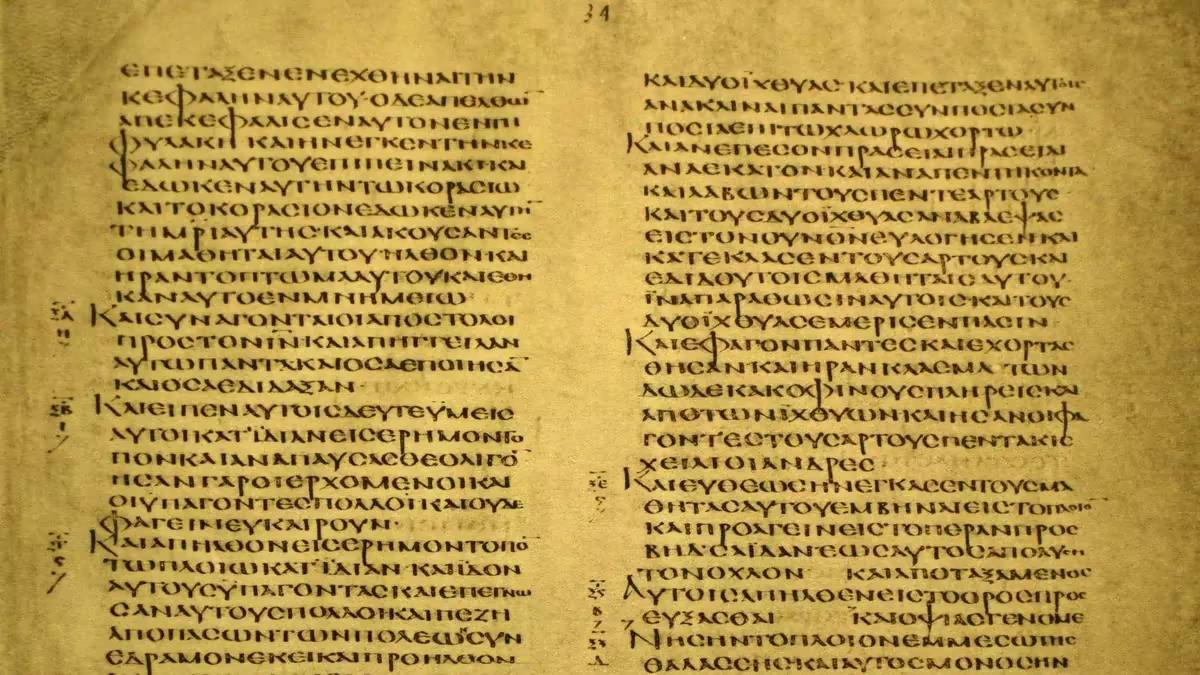
The Bible: the Old Testament held in common
These thirty-nine books appear in every Christian canon. They hold the same material as the twenty-four books of the Tanakh, divided differently.
| Group | Books |
|---|---|
| Law | Genesis, Exodus, Leviticus, Numbers, Deuteronomy |
| History | Joshua, Judges, Ruth, 1 and 2 Samuel, 1 and 2 Kings, 1 and 2 Chronicles, Ezra, Nehemiah, Esther |
| Wisdom and poetry | Job, Psalms, Proverbs, Ecclesiastes, Song of Songs |
| Major Prophets | Isaiah, Jeremiah, Lamentations, Ezekiel, Daniel |
| Minor Prophets | Hosea, Joel, Amos, Obadiah, Jonah, Micah, Nahum, Habakkuk, Zephaniah, Haggai, Zechariah, Malachi |
Books that divide the canons
| Book | Protestant | Catholic | Eastern Orthodox | Ethiopian Tewahedo |
|---|---|---|---|---|
| Tobit | Apocrypha | Canonical | Canonical | Canonical |
| Judith | Apocrypha | Canonical | Canonical | Canonical |
| Wisdom of Solomon | Apocrypha | Canonical | Canonical | Canonical |
| Sirach (Ecclesiasticus) | Apocrypha | Canonical | Canonical | Canonical |
| Baruch, with the Letter of Jeremiah | Apocrypha | Canonical | Canonical | Canonical |
| Additions to Esther | Apocrypha | Canonical | Canonical | Canonical |
| Additions to Daniel | Apocrypha | Canonical | Canonical | Canonical |
| 1 Maccabees | Apocrypha | Canonical | Canonical | Not included |
| 2 Maccabees | Apocrypha | Canonical | Canonical | Not included |
| 3 Maccabees | Not included | Not canonical | Canonical | Not included |
| 4 Maccabees | Not included | Not canonical | Appendix in Greek Bibles | Not included |
| 1 Esdras | Not included | Not canonical | Canonical | Canonical |
| 2 Esdras (4 Ezra) | Not included | Not canonical | In some editions | Canonical |
| Prayer of Manasseh | Not included | Not canonical | Canonical | Canonical |
| Psalm 151 | Not included | Not canonical | Canonical | Canonical |
| Jubilees | Not included | Not included | Not included | Canonical |
| 1 Enoch | Not included | Not included | Not included | Canonical |
| 1, 2 and 3 Meqabyan | Not included | Not included | Not included | Canonical |
The additions to Esther and Daniel are passages within those books, including the Prayer of Azariah, Susanna and Bel and the Dragon. Orthodox practice varies between national churches, which is why the totals are given as a range.
The New Testament
All churches hold the same twenty-seven books.
| Group | Books |
|---|---|
| Gospels | Matthew, Mark, Luke, John |
| History | Acts of the Apostles |
| Letters of Paul | Romans, 1 and 2 Corinthians, Galatians, Ephesians, Philippians, Colossians, 1 and 2 Thessalonians, 1 and 2 Timothy, Titus, Philemon |
| General letters | Hebrews, James, 1 and 2 Peter, 1, 2 and 3 John, Jude |
| Prophecy | Revelation |
How the canons took shape
Early churches used the Septuagint, the Greek translation made for Greek-speaking Jews from the third century BCE, which carried the additional books. Jerome, translating into Latin in the fourth century CE, marked them as useful for edification while holding the Hebrew canon as the standard; the Western church kept them in use for a thousand years. The Reformers returned to the Hebrew canon and printed the remainder separately as the Apocrypha, and the Council of Trent affirmed the longer list for Catholics in 1546. The Orthodox churches never defined their canon as tightly, which accounts for the variation still found among them.
Continue with The Tanakh, The Qur’an or Comparative studies.
See also: Bible Gateway.