
What language did Abraham speak? No inscription records Abraham’s voice, and no scripture names his language. The question can still be answered in two ways: from the world in which Genesis places him, and from the traditions of the peoples who descend from him. The two answers meet more closely than one might expect.
In this article
The world of Abraham
Genesis brings Abraham’s family out of Ur of the Chaldeans to Harran, in the north of Mesopotamia, and from Harran to Canaan.1 In the second millennium BCE the written language of that whole region was Akkadian, set down in cuneiform on clay. It served as the language of diplomacy so completely that, in the fourteenth century BCE, the kings of Babylon and the rulers of the cities of Canaan alike wrote to the pharaohs of Egypt in Akkadian, as the tablets found at Tell el-Amarna show.2 The everyday speech of a family of herdsmen, however, would have been one of the West Semitic dialects of Syria and upper Mesopotamia, the ancestors of Aramaic and Hebrew.
A wandering Aramean
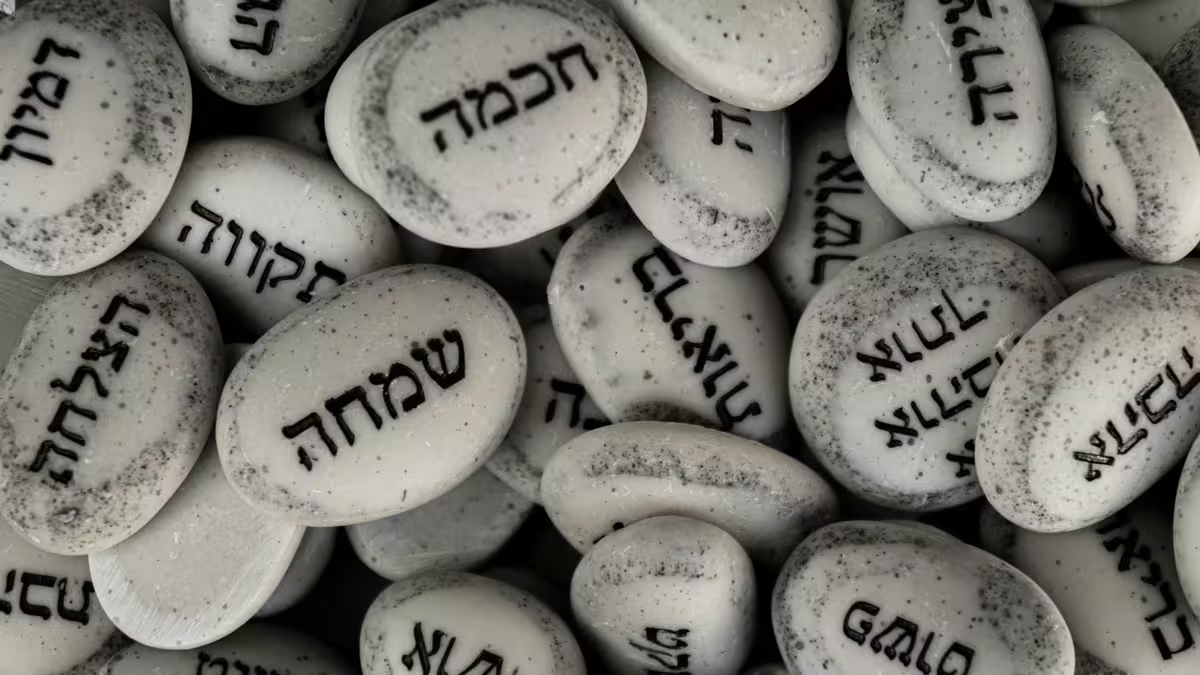
The Bible itself ties the family to the Arameans. Abraham’s brother Nahor stayed in the north, and his descendants, among them Rebekah’s father Bethuel and her brother Laban, are called Arameans. Israel’s own confession of faith begins, ‘A wandering Aramean was my father.’ When Jacob and Laban set up a heap of stones as a witness between them, Laban names it in Aramaic and Jacob in Hebrew: the two branches of one family already spoke two related tongues.3 Hebrew is what the prophet Isaiah calls ‘the language of Canaan’, the speech the family adopted in its new land.4
What the traditions say
Jewish tradition gave Abraham the holy tongue. The Book of Jubilees, from the second century BCE, tells how an angel opened Abraham’s mouth and taught him Hebrew, the language of creation, which had fallen silent among men since Babel.5
Muslim scholars reasoned from the same kinship of languages.
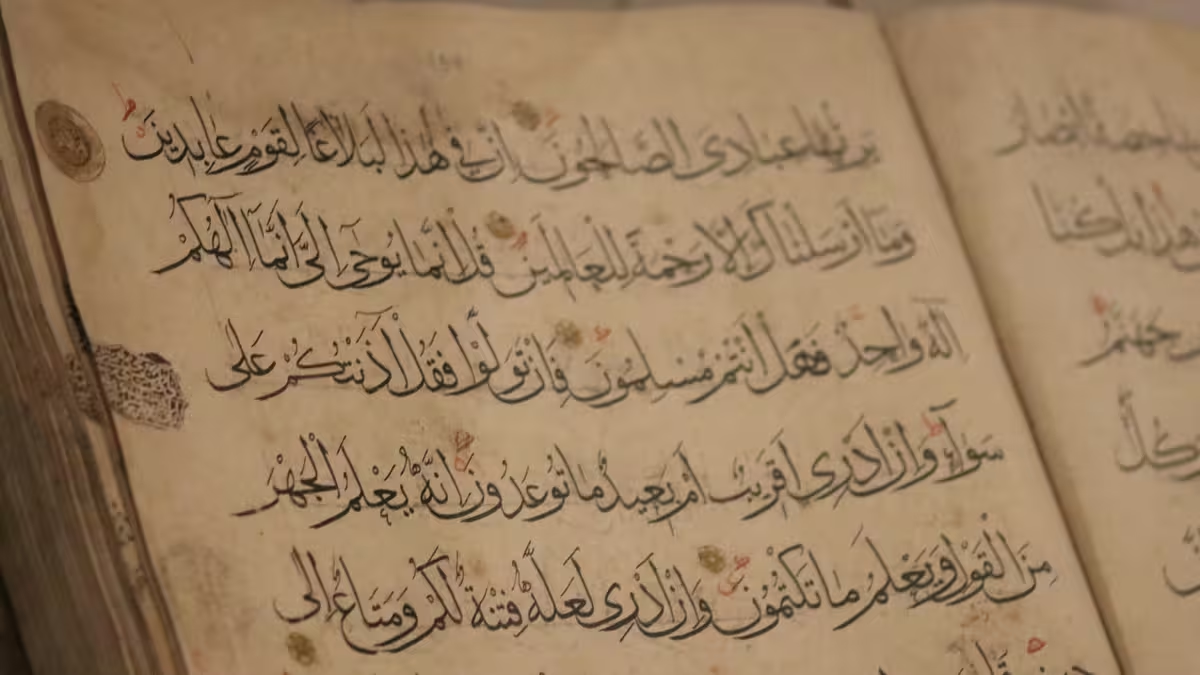
The Andalusian jurist Ibn Ḥazm (d. 1064) observed that Arabic, Hebrew and Syriac differ only as the speech of one people changes over time and place, and concluded that they were once a single language: Syriac was the language of Abraham, Hebrew the language of Isaac and his sons, and Arabic the language of Ishmael and his sons, Ishmael being the first to speak it.6
The hadith of the Prophet preserved by al-Bukhārī tells how the tribe of Jurhum settled beside Hagar and her son at Makkah, and how the boy grew up and learnt Arabic from them.7 Syriac is a form of Aramaic, so the Muslim tradition and the historical evidence arrive at the same family of languages.
In the language of his people
The Qur’an states the principle behind all of this:
وَمَآ أَرْسَلْنَا مِن رَّسُولٍ إِلَّا بِلِسَانِ قَوْمِهِۦ لِيُبَيِّنَ لَهُمْ ۖ فَيُضِلُّ ٱللَّهُ مَن يَشَآءُ وَيَهْدِى مَن يَشَآءُ ۚ وَهُوَ ٱلْعَزِيزُ ٱلْحَكِيمُ ٤
And We did not send any messenger except [speaking] in the language of his people to state clearly for them, and Allāh sends astray [thereby] whom He wills and guides whom He wills. And He is the Exalted in Might, the Wise.
Qur’an 14:48
Abraham, on this principle, preached to the people of Mesopotamia in the language of Mesopotamia, whether an early Aramaic or the Akkadian of its cities. His sons carried two sister tongues into two lands. The revelation to Moses came to the line of Isaac in Hebrew; the last revelation came to the line of Ishmael, in the language Ishmael learnt at Makkah, as ‘an Arabic Qur’an’ so that its hearers might understand.9 The question of Abraham’s language turns out to be the history of prophecy itself: one message, spoken in each case in the tongue of the people to whom it was sent.
What language did Abraham speak? In brief
What language did Abraham speak? The evidence points to the Semitic speech of upper Mesopotamia, the ancestor of Aramaic and Hebrew, with Akkadian as the written language of his world. Muslim scholars such as Ibn Ḥazm called it Syriac, and held that Arabic came down to Ishmael’s line.
Further reading: Who was Abraham?, The path of Abraham in the Qur’an, Where was Abraham from?.
Notes
- Genesis 11:31; 12:4-5. ↩
- Alice Mandell, as summarised in “Missives to the Egyptian Court: The Canaanite Amarna Letters and the scribes who wrote them,” Bible History Daily, Biblical Archaeology Society; “Amarna Letters,” Encyclopaedia Britannica. ↩
- Genesis 22:20-23; 25:20; 31:47; Deuteronomy 26:5; Richard Gottheil et al., “Aramaic Language among the Jews,” Jewish Encyclopedia (1906). ↩
- Isaiah 19:18. ↩
- Jubilees 12:25-27. ↩
- Ibn Ḥazm, al-Iḥkām fī uṣūl al-aḥkām, on the relation of the three languages, as translated at Languagehat, “Ibn Hazm on Arabic, Hebrew and Syriac”; the Arabic text is on Wikisource. ↩
- Ṣaḥīḥ al-Bukhārī 3364, narrated by Ibn ʿAbbās. ↩
- Qur’an 14:4, trans. Saheeh International; Arabic text from Quran.com. ↩
- Qur’an 12:2. ↩