
Jesus was a Jew, and so were all his first disciples. They prayed in the Temple, kept the Sabbath and read the Jewish scriptures. Within three centuries their followers formed a separate religion, most of whose members were Gentiles and whose leaders set its calendar apart from the Jewish one. Scholars call the process the parting of the ways, and they agree that it was gradual: estimates of when it was complete run from the middle of the first century to the middle of the fourth, and the break came at different times in different places.1
A movement within Judaism
The Book of Acts shows the first believers meeting daily in the Temple, and records that the disciples were first called Christians at Antioch.2 The first great question was whether Gentile converts had to become Jews. A council of the apostles at Jerusalem decided that they need not be circumcised or keep the whole law, asking only that they avoid food offered to idols, blood, what is strangled and sexual immorality.3 Paul went further, teaching that a person is made righteous through faith in Christ and not by the works of the law, and he opposed Peter to his face at Antioch over whether Jewish and Gentile believers might eat together.4 See Paul and Peter.
Two wars with Rome
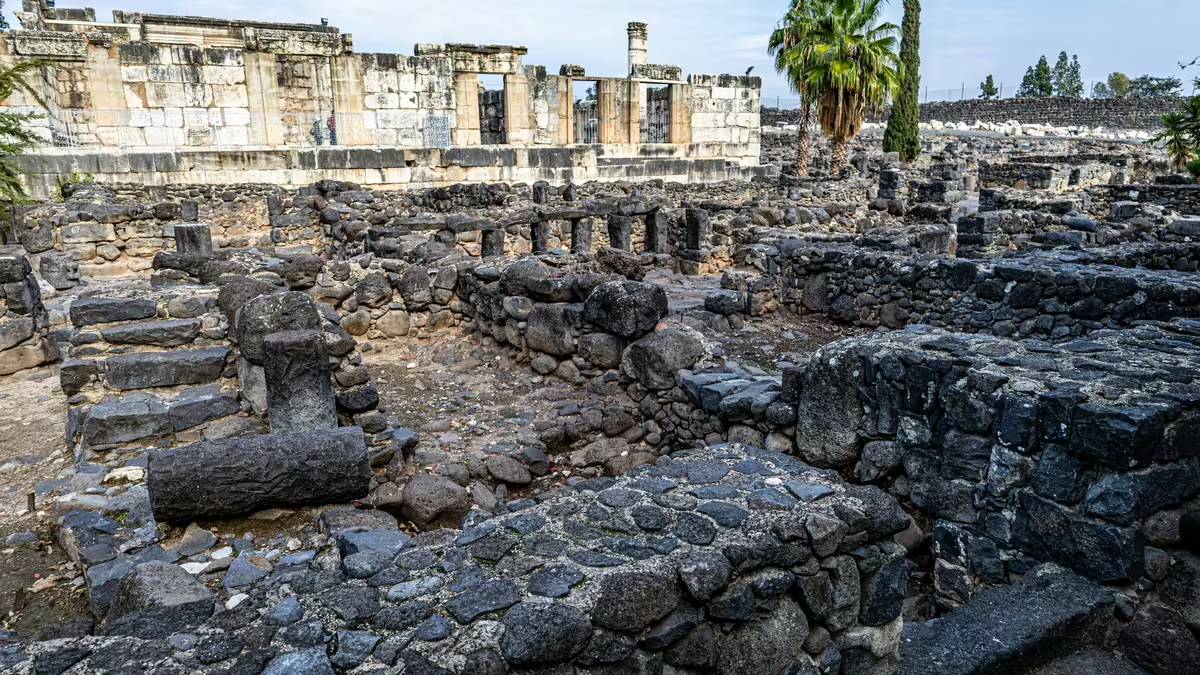
The destruction of the Temple by Rome in 70 CE changed both communities. The Christians of Jerusalem, warned by a revelation according to Eusebius, had left the city before the siege for Pella, across the Jordan.5 Judaism rebuilt itself around the rabbis, the study of the law and the synagogue. Whether the rabbis then added to the daily prayer a curse on heretics aimed at Jewish Christians, the birkat ha-minim, is much debated; the theory that it expelled Christians from the synagogue in the late first century, once widely held, is now contested.6
The second revolt, led by Simon bar Kokhba from 132 to 135, drew a sharper line. Justin Martyr, writing some twenty years later, complained that Bar Kokhba had ordered Christians alone to be punished unless they denied Jesus.7 Jewish Christians could not follow a rival messiah, and after the war Jerusalem was rebuilt as a pagan colony from which Jews were barred.
Two religions
By the fourth century the separation was a matter of law and calendar. At Nicaea in 325 the bishops fixed the date of Easter so that it no longer depended on the Jewish reckoning of Passover. See Nicaea, 325. Some historians still doubt that the ways ever fully parted, pointing to Jews and Christians who continued to share practices for centuries.8
One religion, divided
The Qur’an describes the same pattern in general terms:
كَانَ ٱلنَّاسُ أُمَّةً وَٰحِدَةً فَبَعَثَ ٱللَّهُ ٱلنَّبِيِّـۧنَ مُبَشِّرِينَ وَمُنذِرِينَ وَأَنزَلَ مَعَهُمُ ٱلْكِتَـٰبَ بِٱلْحَقِّ لِيَحْكُمَ بَيْنَ ٱلنَّاسِ فِيمَا ٱخْتَلَفُوا۟ فِيهِ ۚ وَمَا ٱخْتَلَفَ فِيهِ إِلَّا ٱلَّذِينَ أُوتُوهُ مِنۢ بَعْدِ مَا جَآءَتْهُمُ ٱلْبَيِّنَـٰتُ بَغْيًۢا بَيْنَهُمْ ۖ فَهَدَى ٱللَّهُ ٱلَّذِينَ ءَامَنُوا۟ لِمَا ٱخْتَلَفُوا۟ فِيهِ مِنَ ٱلْحَقِّ بِإِذْنِهِۦ ۗ وَٱللَّهُ يَهْدِى مَن يَشَآءُ إِلَىٰ صِرَٰطٍ مُّسْتَقِيمٍ ٢١٣
Mankind was [of] one religion [before their deviation]; then Allāh sent the prophets as bringers of good tidings and warners and sent down with them the Scripture in truth to judge between the people concerning that in which they differed. And none differed over it [i.e., the Scripture] except those who were given it – after the clear proofs came to them – out of jealous animosity among themselves. And Allāh guided those who believed to the truth concerning that over which they had differed, by His permission. And Allāh guides whom He wills to a straight path.
Qur’an 2:2139
The history of the parting follows the verse closely. The first believers were one community with the Jews of their day, sharing one scripture and one Temple. The division came after the scripture had been given, over how it was to be read: over the law, over the Messiah, over who belonged to the covenant. In the Qur’an’s account the prophets brought one religion, and the divisions among those who received their scriptures are the work of their followers. The Qur’an presents itself as the judge between those who differed.
Further reading: Paul and Peter: two missions in the early church, Nicaea, 325, Jesus across the traditions.
Notes on the parting of the ways
- Anne Amos, “The Parting of the Ways,” Jewish-Christian Relations (jcrelations.net); Mariusz Rosik, Church and Synagogue (30-313 AD): Parting of the Ways (Berlin: Peter Lang, 2019). ↩
- Acts 2:46; 11:26. ↩
- Acts 15:1-29. ↩
- Galatians 2:11-16. ↩
- Eusebius, Ecclesiastical History 3.5.3. ↩
- Joel Marcus, “Birkat ha-Minim Revisited,” New Testament Studies 55 (2009), discussing the thesis of J. Louis Martyn. ↩
- Justin Martyr, First Apology 31.6. ↩
- “The Ways that Never Parted: A Roundtable,” Studies in Late Antiquity 9 (2025), pp. 373-429. ↩
- Qur’an 2:213, trans. Saheeh International; Arabic text from Quran.com. ↩