
The ‘Islamic Dilemma’ is an argument made by Christian apologists against Islam, popularised above all by the American apologist David Wood.1 Its shape is simple. The Qur’an, it says, affirms the Torah and the Gospel. If the Gospel is the word of God, Islam is false because it contradicts the Gospel; if the Gospel is not the word of God, Islam is false because the Qur’an affirmed it. As the argument’s own website puts it, “By affirming scriptures that contradict its core teachings, Islam self-destructs.”2 This article sets out the argument at its strongest, and then examines the premises on which it rests.
In this article
The argument at its strongest
The dilemma draws on a group of verses. The Qur’an says that God sent down the Book ‘confirming what was before it’, as He had sent down the Torah and the Gospel as guidance for the people.3
It says that God gave Jesus the Gospel, ‘in which was guidance and light’, and tells the people of the Gospel to judge by what God has revealed in it.4 It tells the People of the Scripture that they stand on nothing until they uphold the Torah and the Gospel.5 And it tells the Prophet that if he is in doubt about what has been revealed to him, he should ask those who have been reading the scripture before him.6
From these verses proponents build three premises: that the Qur’an treats the Torah and Gospel of the seventh century as authoritative; that the Bible of the seventh century is, by the manuscript evidence, essentially the Bible of today; and that this Bible contradicts the Qur’an on the divinity of Christ and on the crucifixion.7 Each of the three can be tested.
What {Q}confirming{Q} means
The word the verses use for the Qur’an’s relation to earlier scripture is muṣaddiq (مُصَدِّق, confirming, declaring true). The same passage that the dilemma quotes goes on to give the Qur’an a second title: it is sent down ‘confirming that which preceded it of the Scripture and as a criterion over it’, muhayminan ʿalayhi (مُهَيْمِنًا عَلَيْهِ, a guardian over it).8 Ibn ʿAbbās, the Prophet’s cousin, explained the word as trustee: the Qur’an is trustee over every scripture before it.9 The early exegete al-Ṭabarī drew the consequence: whatever in the earlier books agrees with the Qur’an is true, and whatever disagrees with it is false.10
The confirmation the dilemma relies on is therefore a confirmation under judgement. The Qur’an affirms that God revealed the Torah and the Gospel, affirms the truths that remain in the scriptures of Jews and Christians, and claims the right to say which parts those are. The first premise, that the Qur’an endorses the seventh-century text as it stood, reads only half of the verse on which it depends.
Which Gospel?
The Qur’an speaks of one Gospel, the Injīl (إِنجِيل), which God ‘gave’ to Jesus. The New Testament contains four Gospels, each bearing the name of a later writer, and one of them opens by explaining that its author compiled his account from what had been handed down by eyewitnesses.11 The dilemma assumes that the Injīl of the Qur’an is simply the four Gospels of the Christian canon. That identification is the Christian reading of the Qur’an, and the Qur’an does not make it. On the Muslim reading, the Injīl is the revelation given to Jesus, which the four Gospels preserve in part, together with much that was written about him by others.
The Qur’an already speaks of alteration
The dilemma presents the Muslim charge of corruption as a later excuse that the Qur’an itself does not support. The Qur’an says otherwise, in the same period it was revealed.
It condemns those who write scripture with their own hands and then say it is from God; it describes a party among the People of the Book who twist the scripture with their tongues so that it may be taken for scripture; and it says that some of them distort words from their proper places and have forgotten a portion of what they were reminded of.12 The Qur’an that confirms is the same Qur’an that corrects, and it does both in the seventh century. There is no contradiction for the Muslim to escape: the Qur’an never claimed that every text in the hands of its hearers was intact.
Read this way, the verses the dilemma cites fall into place. The people of the Gospel are told to judge by what God has revealed in it: by the truths that remain there, such as the oneness of God and the coming of a prophet described in their own scriptures.13 And the verse about asking those who read the scripture concerned, for many classical exegetes, the Prophet’s own description in their books; others held that the Prophet neither doubted nor asked, and that the verse addresses his hearers through him.14
The Bible of the seventh century
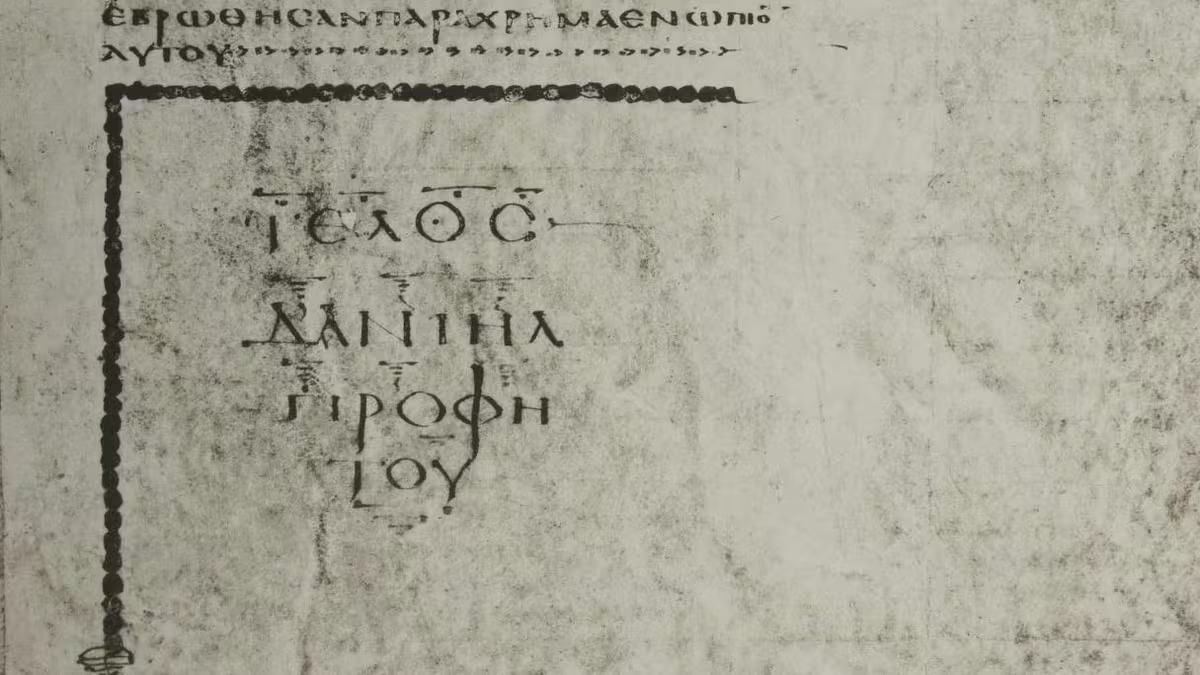
The second premise, that the Bible of the seventh century is essentially the Bible of today, turns against the argument once it is examined. The Bible of the seventh century already contained passages that Christian scholars now recognise as later additions.
The last twelve verses of Mark are absent from the two oldest complete Greek Bibles, Codex Vaticanus and Codex Sinaiticus; Eusebius and Jerome both knew that most Greek copies of their day lacked them, and most New Testament scholars regard them as a second-century addition.15 Many modern Bibles print a note that the earliest manuscripts lack the story of the woman taken in adultery.16 A Bible that had grown by the seventh century is exactly the kind of text over which the Qur’an claims the right of a guardian.
The verse that answers the dilemma
The whole question is settled by the verse that follows the passage the dilemma quotes most often:
وَأَنزَلْنَآ إِلَيْكَ ٱلْكِتَـٰبَ بِٱلْحَقِّ مُصَدِّقًا لِّمَا بَيْنَ يَدَيْهِ مِنَ ٱلْكِتَـٰبِ وَمُهَيْمِنًا عَلَيْهِ ۖ فَٱحْكُم بَيْنَهُم بِمَآ أَنزَلَ ٱللَّهُ ۖ وَلَا تَتَّبِعْ أَهْوَآءَهُمْ عَمَّا جَآءَكَ مِنَ ٱلْحَقِّ ۚ لِكُلٍّ جَعَلْنَا مِنكُمْ شِرْعَةً وَمِنْهَاجًا ۚ وَلَوْ شَآءَ ٱللَّهُ لَجَعَلَكُمْ أُمَّةً وَٰحِدَةً وَلَـٰكِن لِّيَبْلُوَكُمْ فِى مَآ ءَاتَىٰكُمْ ۖ فَٱسْتَبِقُوا۟ ٱلْخَيْرَٰتِ ۚ إِلَى ٱللَّهِ مَرْجِعُكُمْ جَمِيعًا فَيُنَبِّئُكُم بِمَا كُنتُمْ فِيهِ تَخْتَلِفُونَ ٤٨
And We have revealed to you, [O Muḥammad], the Book [i.e., the Qur’ān] in truth, confirming that which preceded it of the Scripture and as a criterion over it. So judge between them by what Allāh has revealed and do not follow their inclinations away from what has come to you of the truth. To each of you We prescribed a law and a method. Had Allāh willed, He would have made you one nation [united in religion], but [He intended] to test you in what He has given you; so race to [all that is] good. To Allāh is your return all together, and He will [then] inform you concerning that over which you used to differ.
Qur’an 5:4817
The dilemma quotes the Qur’an as a witness to the Bible and stops before the verse that explains what kind of witness it is. The Qur’an confirms and guards at once: it declares true what God revealed to Moses and to Jesus, and it stands over the texts that later carried that revelation as the criterion that separates what remains of it from what was added. A dilemma needs two horns, and each of these rests on a premise the Qur’an rejects. The Muslim can hold without contradiction that God gave Jesus the Gospel, that the Christian scriptures preserve some of it, and that the Qur’an is the judge of which parts those are.
Further reading: What is the Islamic Dilemma?, The preservation and transmission of scripture, Understanding the Bible and the Qur’an in historical context, Jesus across the traditions, The Islamic Dilemma, refuted (The Muslim Apologist).
Notes on the Islamic Dilemma
- “The Islamic Dilemma,” Hold Fast Apologetics, 2 March 2026; “The Islamic Dilemma: A Scholarly Breakdown by Rudolph P. Boshoff,” Ad Lucem Ministries, 2 October 2025. ↩
- “What is the ‘Islamic Dilemma’?,” The Islamic Dilemma (islamicdilemma.com). ↩
- Qur’an 3:3-4. ↩
- Qur’an 5:46-47. ↩
- Qur’an 5:68. ↩
- Qur’an 10:94. ↩
- “The Islamic Dilemma: The Quran, the Bible, and a Two-Horned Trap,” Apologia Daily, 28 June 2026. ↩
- Qur’an 5:48. ↩
- Ṣaḥīḥ al-Bukhārī, Book of the Virtues of the Qur’an, chapter 1, the comment of Ibn ʿAbbās on al-muhaymin. ↩
- Ibn Kathīr, Tafsīr al-Qur’ān al-ʿAẓīm, on Qur’an 5:48, quoting Ibn Jarīr al-Ṭabarī and the reports from Ibn ʿAbbās. ↩
- Luke 1:1-4. ↩
- Qur’an 2:79; 3:78; 5:13. ↩
- Qur’an 7:157; cf. Mark 12:29. ↩
- Waleed Blyth, note to Qur’an 10:94, The Qur’an: English translation, Quranenc.com, citing al-Ṭabarī, Ibn ʿAṭiyyah and Ibn Kathīr, and al-Wāḥidī, al-Baghawī and Ibn ʿĀshūr. ↩
- “‘The Earliest Manuscripts Do Not Have …’: How to Preach Mark 16 and John 8,” Logos. ↩
- New International Version, note at John 7:53-8:11. ↩
- Qur’an 5:48, trans. Saheeh International; Arabic text from Quran.com. ↩