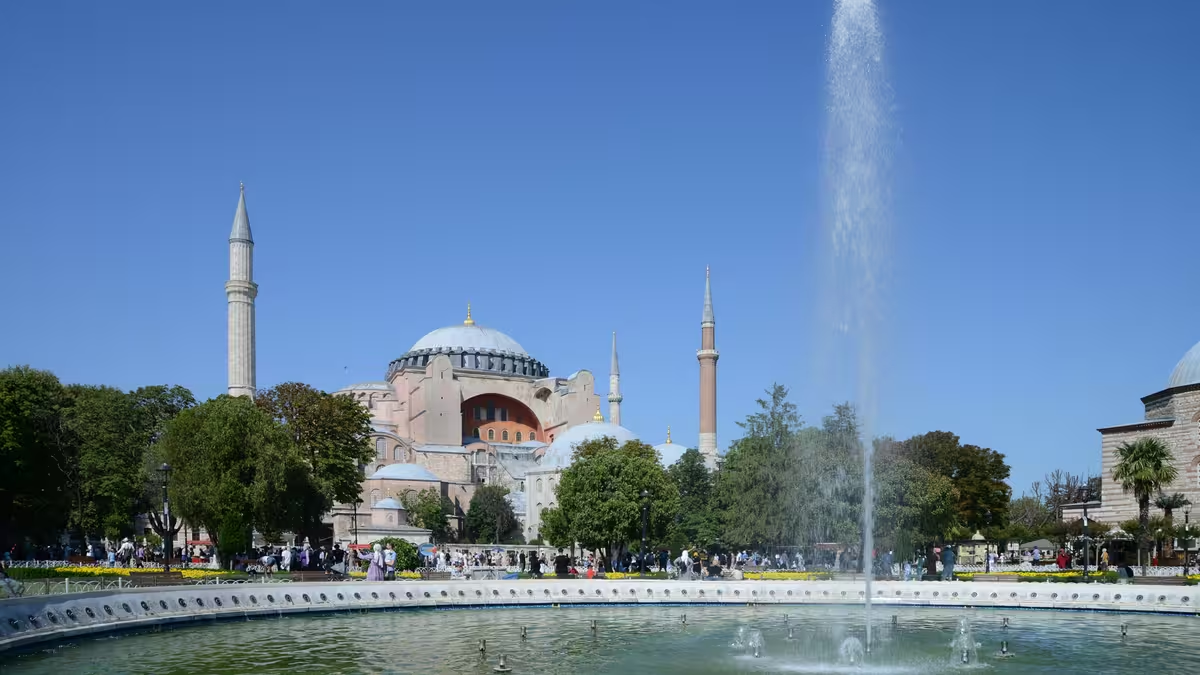
Few buildings have served so many faiths and governments. For more than nine centuries Hagia Sophia, the church of Holy Wisdom in Constantinople, was the cathedral of the Eastern Roman empire; for nearly five it was the foremost mosque of the Ottoman state; for eighty-six years it was a museum; and since 2020 it has been a mosque again.
Three churches on one site
The present building is the third on its site. The first, dedicated in 360 by the emperor Constantius, was destroyed in riots in 404; the second, dedicated by Theodosius II in 415, burned in the Nika revolt of 532, which laid waste much of the city. Justinian ordered the church rebuilt at once, and the new building, designed by Anthemius of Tralles and Isidore of Miletus, was inaugurated on 27 December 537. Its dome, more than thirty-one metres across, collapsed in 558 after a series of earthquakes and was rebuilt in 562 to a greater height; the structure that stands today is essentially the one raised between 532 and 537.1
Procopius, the historian of Justinian’s reign, left the description that later writers repeated for centuries. The dome, he wrote, seemed to hang from heaven on a golden chain, with no solid masonry beneath it.2
The cathedral of the East
As the cathedral of the patriarch of Constantinople, Hagia Sophia witnessed the great quarrels of Eastern Christianity. On 16 July 1054 the papal legate Cardinal Humbert laid a bull excommunicating the patriarch Michael Cerularius on its altar, in full view of the congregation; the patriarch replied by excommunicating the legates.3 Later tradition made that scene the start of the schism between the Latin and Greek churches, a view that historians of the period no longer hold: the break was gradual, and no single event caused it.4
The decisive wound came from fellow Christians. In April 1204 the Fourth Crusade, diverted from its march on Egypt, stormed Constantinople and sacked it. The Byzantine historian Niketas Choniates, an eyewitness, recorded that the altar of the Great Church was broken into pieces and divided among the soldiers.5 A Latin, Thomas Morosini, was installed as patriarch, and Hagia Sophia served the Latin church until the Byzantines retook the city in 1261.6
The imperial mosque
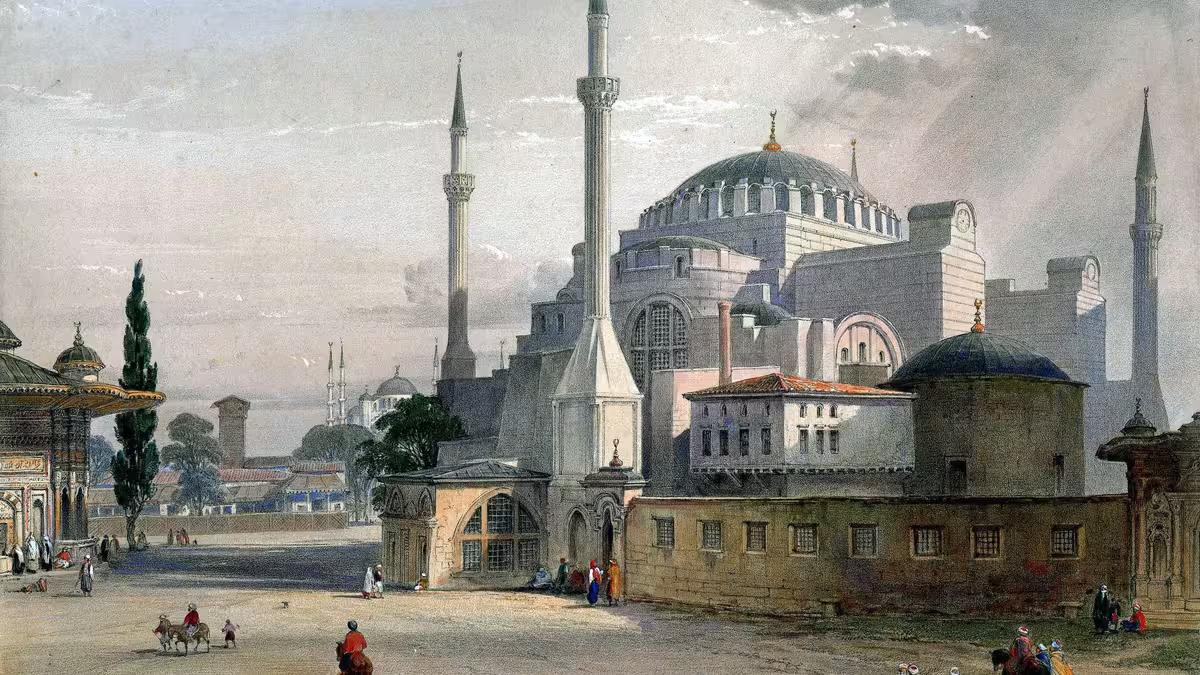
After the Ottoman conquest of Constantinople in 1453, Mehmed II converted Hagia Sophia into a mosque.7 Minarets rose around it, its figural mosaics were covered, and buttresses were added to strengthen its walls. The building became the personal property of the sultan, so that no change could be made to it without his consent; that protection is one reason its mosaics survived beneath their plaster.8
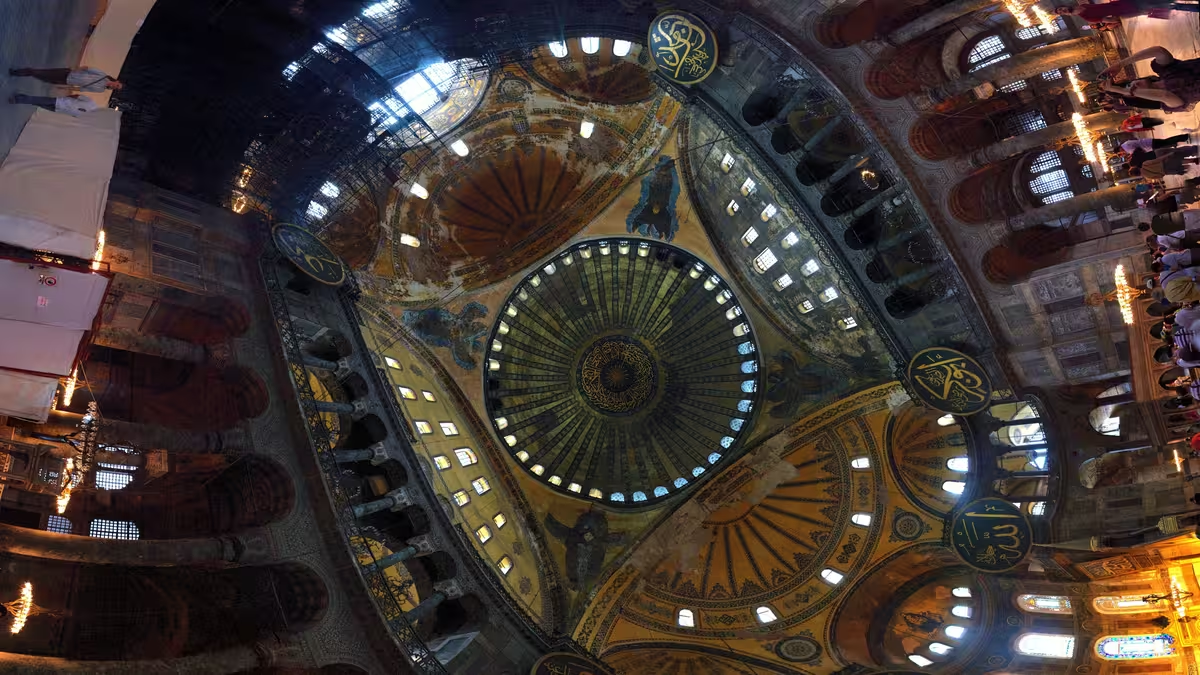
Between 1847 and 1849 Sultan Abdülmecid had the building restored by the Swiss-Italian architects Gaspare and Giuseppe Fossati, whose teams reinforced the dome, cleaned the mosaics and renewed the mihrab and the minbar. During that restoration the calligrapher Kazasker Mustafa İzzet Efendi wrote the eight great roundels, seven and a half metres across, that still hang in the prayer hall, bearing in gold the names of God, the Prophet Muhammad, the four rightly guided caliphs and the Prophet’s grandsons Hasan and Husayn.9 In the crown of the dome he inscribed a verse from the chapter of Light.10
Museum and mosque again
In 1934 the government of the new Turkish Republic under Mustafa Kemal Atatürk made Hagia Sophia a museum.11 It became part of the UNESCO World Heritage site of the Historic Areas of İstanbul in 1985.9 In July 2020 Türkiye’s Council of State annulled the decree of 1934, and a presidential decree returned the building to use as a mosque, with prayers from 24 July.7 Ecumenical Patriarch Bartholomew protested that Hagia Sophia “belongs not only to those who own it at the moment, but to all humanity.”7 It remains open to visitors outside the times of prayer.
The verse in the dome
The verse inscribed at the summit of the dome is the verse of Light:
ٱللَّهُ نُورُ ٱلسَّمَـٰوَٰتِ وَٱلْأَرْضِ ۚ مَثَلُ نُورِهِۦ كَمِشْكَوٰةٍ فِيهَا مِصْبَاحٌ ۖ ٱلْمِصْبَاحُ فِى زُجَاجَةٍ ۖ ٱلزُّجَاجَةُ كَأَنَّهَا كَوْكَبٌ دُرِّىٌّ يُوقَدُ مِن شَجَرَةٍ مُّبَـٰرَكَةٍ زَيْتُونَةٍ لَّا شَرْقِيَّةٍ وَلَا غَرْبِيَّةٍ يَكَادُ زَيْتُهَا يُضِىٓءُ وَلَوْ لَمْ تَمْسَسْهُ نَارٌ ۚ نُّورٌ عَلَىٰ نُورٍ ۗ يَهْدِى ٱللَّهُ لِنُورِهِۦ مَن يَشَآءُ ۚ وَيَضْرِبُ ٱللَّهُ ٱلْأَمْثَـٰلَ لِلنَّاسِ ۗ وَٱللَّهُ بِكُلِّ شَىْءٍ عَلِيمٌ ٣٥
Allah is the Light of the heavens and the earth. His light is like a niche in which there is a lamp, the lamp is in a crystal, the crystal is like a shining star, lit from ˹the oil of˺ a blessed olive tree, ˹located˺ neither to the east nor the west, whose oil would almost glow, even without being touched by fire. Light upon light! Allah guides whoever He wills to His light. And Allah sets forth parables for humanity. For Allah has ˹perfect˺ knowledge of all things.
Qur’an 24:3512
Procopius believed that the dome hung from heaven; the builders ringed its base with windows so that light seemed to hold it up. Since the nineteenth century the dome itself has named the source of that light. The verse that follows it in the Qur’an speaks of houses which God has ordered to be raised and in which His name is mentioned, glorified there morning and evening,13 and another verse declares that the masājid (ٱلْمَسَـٰجِد, the places of prostration) belong to God, so that none is to be invoked beside Him.14 A building raised to glorify Holy Wisdom under a creed that made Christ one of three has for most of its later history been such a house: the name of the one God is proclaimed beneath a dome that bears His verse of Light.
The history also shows how much the building owes to its Muslim custodians. The crusaders who shared its altar among themselves as plunder were Christians; the sultans who received it in 1453 kept its structure standing, restored it, and preserved the mosaics of its former faith as their own property.58 See The five great sees of the early church and Nicaea, 325.
Further reading: The five great sees of the early church, Nicaea, 325: the council, the creed and the church beneath the lake, Islam.
Notes
- “Hagia Sophia,” Historic Civil Engineering Landmarks, American Society of Civil Engineers. ↩
- Procopius, Buildings 1.1.46, in the translation reproduced by the Department of Art History and Archaeology, Columbia University. ↩
- “Saint Leo IX,” Encyclopaedia Britannica. ↩
- “1054 The East-West Schism,” Christian History Magazine, Christian History Institute. ↩
- Niketas Choniates, The Sack of Constantinople (1204), Internet Medieval Sourcebook, Fordham University. ↩
- “The Fourth Crusade,” The Orthodox Faith, vol. 3, Orthodox Church in America. ↩
- Nathan Morley, “Turkey: Hagia Sophia Basilica to become mosque,” Vatican News, 10 July 2020. ↩
- “Hagia Sophia Throughout History: One Dome, Three Religions,” TheCollector, 26 July 2022. ↩
- “Hagia Sophia / Ayasofya,” Museums of Türkiye (muze.gen.tr), Ministry of Culture and Tourism. ↩
- “Hagia Sophia, Mosque of Sultans,” Skylife, August 2013; “Hagia Sophia Istanbul Interior,” TheHagiaSophia.com, 12 June 2025, identifying the verse as Qur’an 24:35. ↩
- “Hagia Sophia, Istanbul,” Smarthistory. ↩
- Qur’an 24:35, trans. Mustafa Khattab, The Clear Quran; Arabic text from Quran.com. ↩
- Qur’an 24:36, trans. Saheeh International. ↩
- Qur’an 72:18, trans. Saheeh International. ↩