The great sees of the early church were five: Rome, Constantinople, Alexandria, Antioch and Jerusalem. By the sixth century five cities stood at the head of the Christian church in the Roman empire: Rome, Constantinople, Alexandria, Antioch and Jerusalem. Later historians call the arrangement the pentarchy, the rule of five. It grew over three centuries, from the councils of the church and the laws of the emperors, and it ended in practice within a century of taking its final shape.
In this article
How the ranking began
The first step came at the Council of Nicaea in 325. Its sixth canon confirmed the ancient authority of the bishop of Alexandria over Egypt, Libya and Pentapolis, on the ground that the bishop of Rome held a similar authority, and preserved the privileges of the church of Antioch; its seventh granted special honour to the bishop of Aelia, the Roman name for Jerusalem.1 Nicaea itself was never one of the great sees. It is the place where their ranking was first written down; see Nicaea, 325.
Constantinople, the new imperial capital, entered the order later. The Council of Constantinople in 381 placed its bishop second in honour after the bishop of Rome, and the Council of Chalcedon in 451 confirmed and extended that position.2 The emperor Justinian gave the five sees their classic form in his legislation, above all in his Novel 131, and the Council in Trullo in 692 ranked them as Rome, Constantinople, Alexandria, Antioch and Jerusalem.3
The order rested on more than one principle, and the principles did not always agree. The great sees owed much of their standing to the political and economic weight of their cities; Constantinople ranked second because it was the capital. The bishops of Rome held instead that only churches founded by apostles could claim primacy, a view that set them against the rise of Constantinople.4
The five sees
Rome, the old capital, claimed the first place as the church of the apostles Peter and Paul, and its bishops argued for that primacy on apostolic grounds.4 St Peter’s Basilica in Vatican City stands over the traditional site of Peter’s tomb.
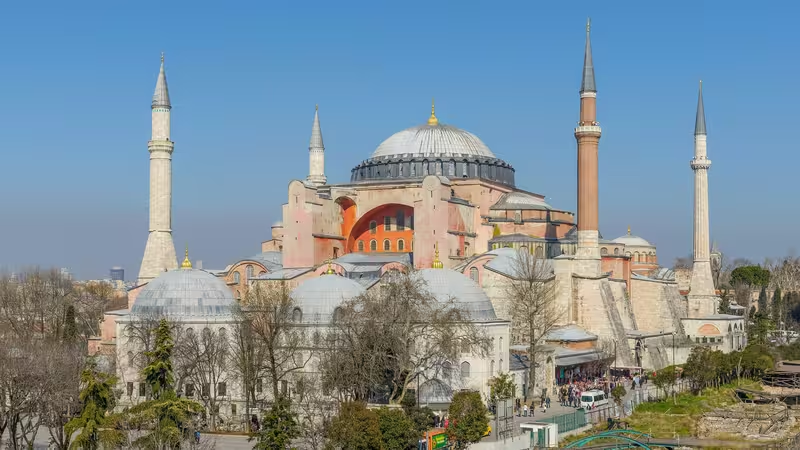
Constantinople, the “New Rome” on the Bosporus, was the seat of the emperor and so of the second patriarch. Its great church, Hagia Sophia, was completed under Justinian in 537 and served as the patriarch’s cathedral until the Ottoman conquest of 1453, when it became a mosque. It was a museum from 1934 and has been a mosque again since 2020.5
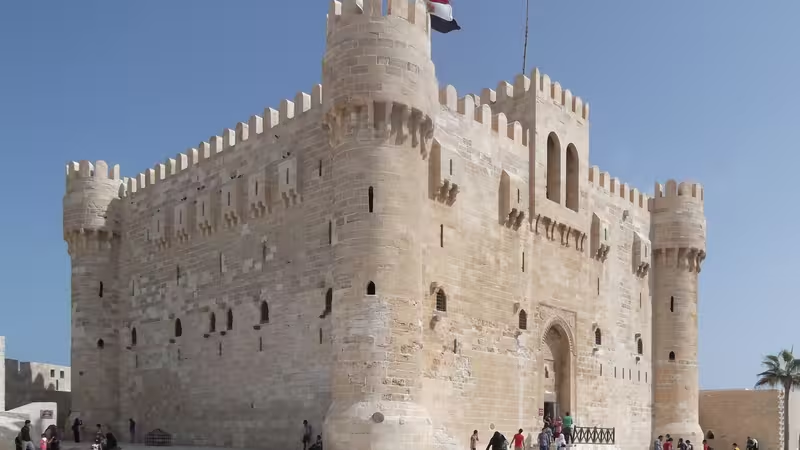
Alexandria traced its church to Mark, who, as Eusebius reports the tradition, was the first sent to Egypt and first established churches in the city.6 In the early fourth century it was the city of Arius, whose teaching about the Son led to the Council of Nicaea, and of the young deacon Athanasius, who became its chief opponent.7
Antioch was where the followers of Jesus were first called Christians,8 and where Paul confronted Peter over the table fellowship of Jewish and Gentile believers; see Paul and Peter: two missions in the early church.9
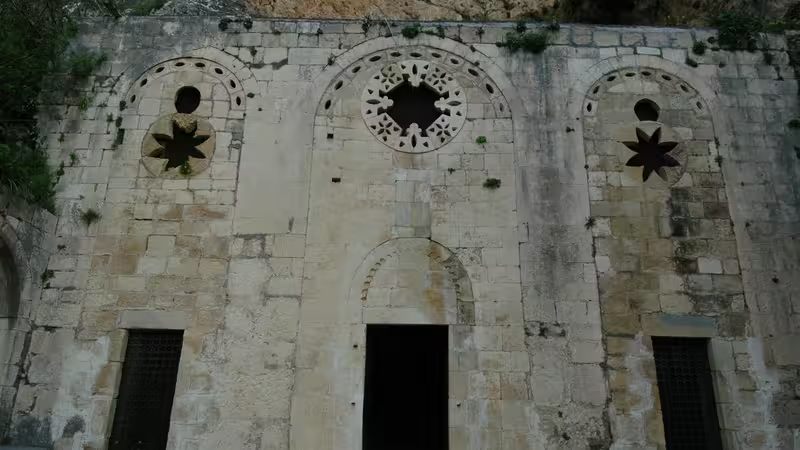
Jerusalem, the city of the crucifixion and of the first church, held the fifth place. At Nicaea it was still a suffragan of Caesarea, and its bishop was granted honour “saving the dignity proper to the metropolitan”; only later did it take its place among the five.1
After the seventh century
The arrangement assumed a single Christian empire, and that empire did not last in the East. In the seventh century Alexandria, Antioch and Jerusalem came under Muslim rule, and the pentarchy lost its practical force: the patriarch of Constantinople remained the only effective head of Eastern Christianity, and new churches in Bulgaria, Serbia and Russia in time acquired their own patriarchs.3 The three eastern sees did not disappear. Their patriarchs lived on under Muslim government, and all three still have patriarchs today, alongside the pope in Rome and the ecumenical patriarch in Istanbul.
Further reading: Nicaea, 325: the council, the creed and the church beneath the lake, Paul and Peter: two missions in the early church, Christianity, Hagia Sophia: cathedral, mosque, museum and mosque again.
Notes on the great sees
- Norman P. Tanner, ed., Decrees of the Ecumenical Councils, vol. 1 (London: Sheed & Ward, 1990), First Council of Nicaea, canons 6-7, as reproduced by Papal Encyclicals Online. ↩
- “The Pentarchy and the Moscow Patriarchate,” OrthoChristian.com, on canon 3 of Constantinople I and canon 28 of Chalcedon. ↩
- “Pentarchy,” Encyclopaedia Britannica. ↩
- Ibid. ↩
- Nathan Morley, “Turkey: Hagia Sophia Basilica to become mosque,” Vatican News, 10 July 2020. ↩
- Eusebius, Church History 2.16.1, trans. A. C. McGiffert, Nicene and Post-Nicene Fathers, second series, vol. 1 (New York, 1890). ↩
- “First Council of Nicaea,” The Catholic Encyclopedia, vol. 11 (New York: Robert Appleton Company, 1911). ↩
- Acts 11:26. ↩
- Galatians 2:11-14. ↩