
Each of the four traditions is recognised today by a symbol: the six-pointed star, the Mandaean banner, the cross and the crescent. Only some of these are as old as they look, and one tradition, strictly, has no sacred symbol at all.
The Star of David
The six-pointed star, the Magen David or Shield of David, has no authority in the Bible or the Talmud. It was used for centuries as a decoration and a charm by many peoples, Jews among them, and Jewish mystics of the Middle Ages ascribed powers to it. The Jewish community of Prague was the first to adopt it as an official emblem; from the seventeenth century many communities used it on their seals, and in the nineteenth century Jews adopted it almost everywhere as a simple sign of Judaism, in imitation of the Christian cross. The yellow star forced on Jews in Nazi-occupied Europe gave it a further meaning of martyrdom.1 The older Jewish emblem is the seven-branched lampstand of the Temple, the menorah, which appears on the Arch of Titus in Rome and is the emblem of the State of Israel today.
The Mandaean banner
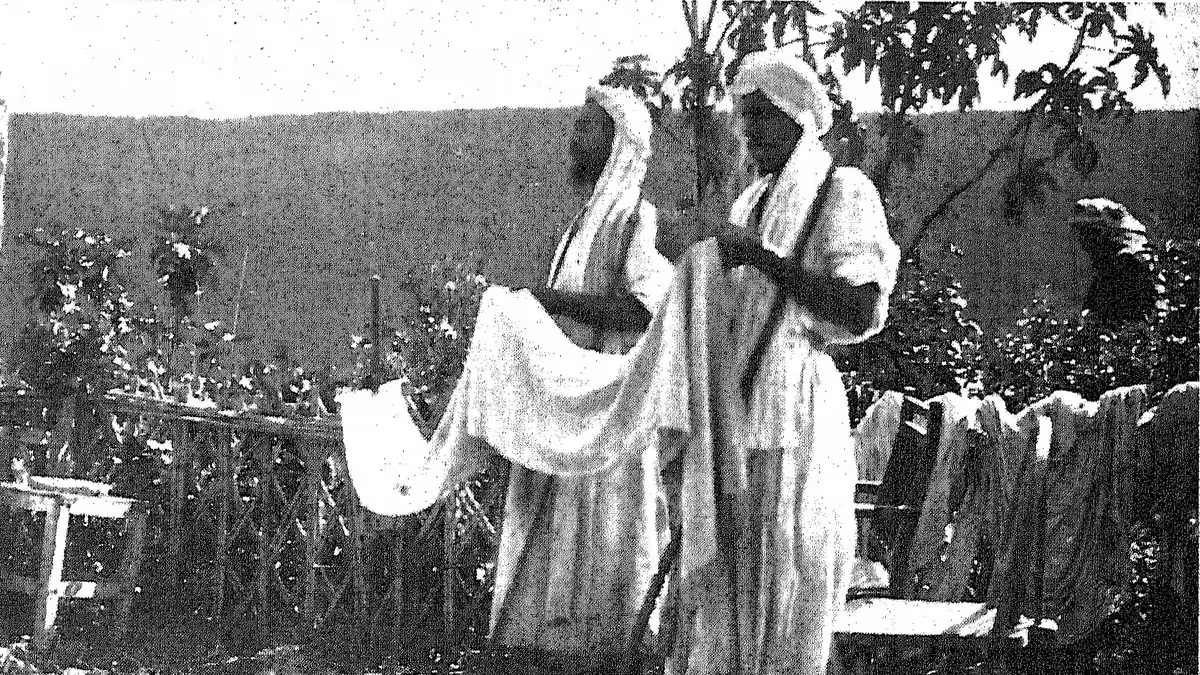
The Mandaean drabsha, the banner, is a pole with a cross-piece from which hangs a long strip of unbleached white silk, crowned with a myrtle wreath. It stands beside the river at baptisms. E. S. Drower, who watched it consecrated, recorded that the cross-piece had led some observers to see in Mandaeism a form of Christianity, and rejected the idea: the banner, she wrote, is purely a symbol of light, and it is the silk, never the wooden staff, that has ritual meaning.2
The cross
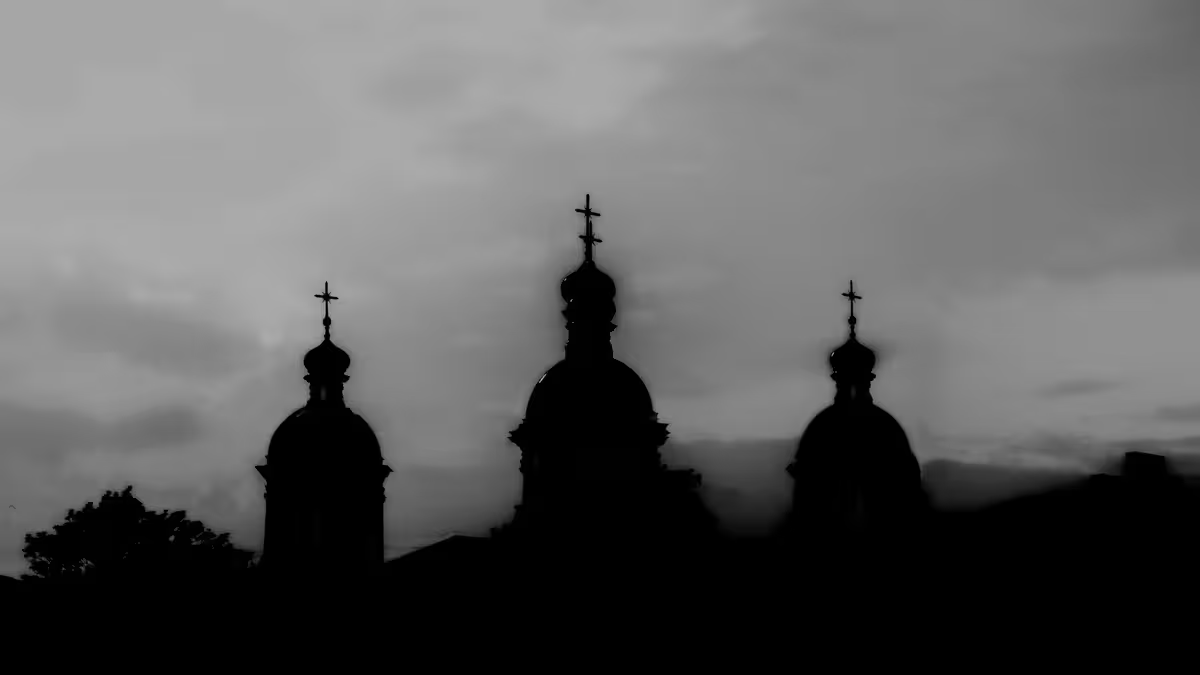
The cross stands for the crucifixion, yet for three centuries Christians hardly showed it. Clement of Alexandria, around 200, recommended a dove, a fish, a ship, a lyre and an anchor as fit images for a Christian’s seal ring; the fish was prized because its Greek name, ichthys, spelled the initials of ‘Jesus Christ, Son of God, Saviour’.3 Before Constantine, Christians were reluctant to display the cross because it exposed them to ridicule and danger. Constantine abolished crucifixion as a punishment and promoted the cross and the chi-rho monogram, and from about 350 they became the common emblems of Christian art.4
The crescent
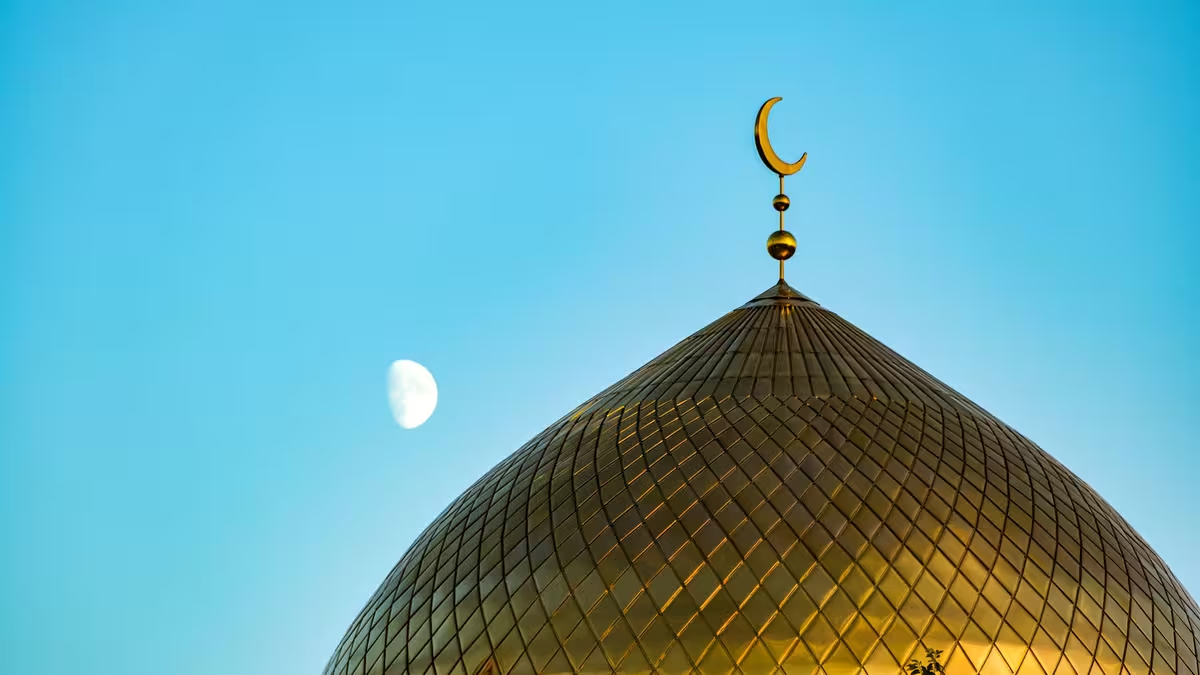
The crescent is the youngest of the four as a religious emblem. The moon in its first quarter was a sign of the goddess Astarte in the ancient Near East and later of the city of Byzantium. The Ottoman Turks carried it on the standards of their infantry under Sultan Orhan in the fourteenth century, and it became so closely tied to the Ottoman state, its flags and the tops of its minarets that it came to stand for the Muslim world as a whole. It appears on the flags of Türkiye, Pakistan, Malaysia and other Muslim countries, and in the Red Crescent.5 The first Muslims had no such emblem: the armies of the Prophet’s time carried plain flags of a single colour for identification.6
A religion without an emblem
Islam’s lack of a sacred symbol follows from its idea of worship. Muslims pray toward a place, the Kaaba, and decorate their mosques with the written word, above all the name of God, and with geometry and plants, avoiding images of living beings in worship. The crescent is a useful sign on a map or a minaret, and many Muslims value it as such, but no Muslim prays to it, and the faith would be complete without it.
Further reading: The Abrahamic family tree and what the traditions share, Maṣbūtā: baptism in running water, Hagia Sophia.
Notes
- “Star of David,” Encyclopaedia Britannica. ↩
- E. S. Drower, The Mandaeans of Iraq and Iran (Oxford: Clarendon Press, 1937), pp. 108-109. ↩
- “When did the cross supplant the ichthus (fish) as a symbol of the Christian faith?,” Christian History, Christianity Today, 26 February 2009. ↩
- “Cross,” Encyclopaedia Britannica. ↩
- “Crescent,” Encyclopaedia Britannica. ↩
- “Is the crescent moon the symbol of Islam?,” Fiqh, IslamOnline. ↩