
In July 2026 archaeologists at İznik, the ancient city of Nicaea in north-western Türkiye, reported the remains of an earlier church beneath the basilica on the shore of Lake İznik. The excavation director identifies it as the church in which the bishops of the First Council of Nicaea met in 325, the gathering that fixed the central Christian doctrine about Jesus.1 Several outlets have since reported the find, from the region and abroad.2
The church beneath the lake
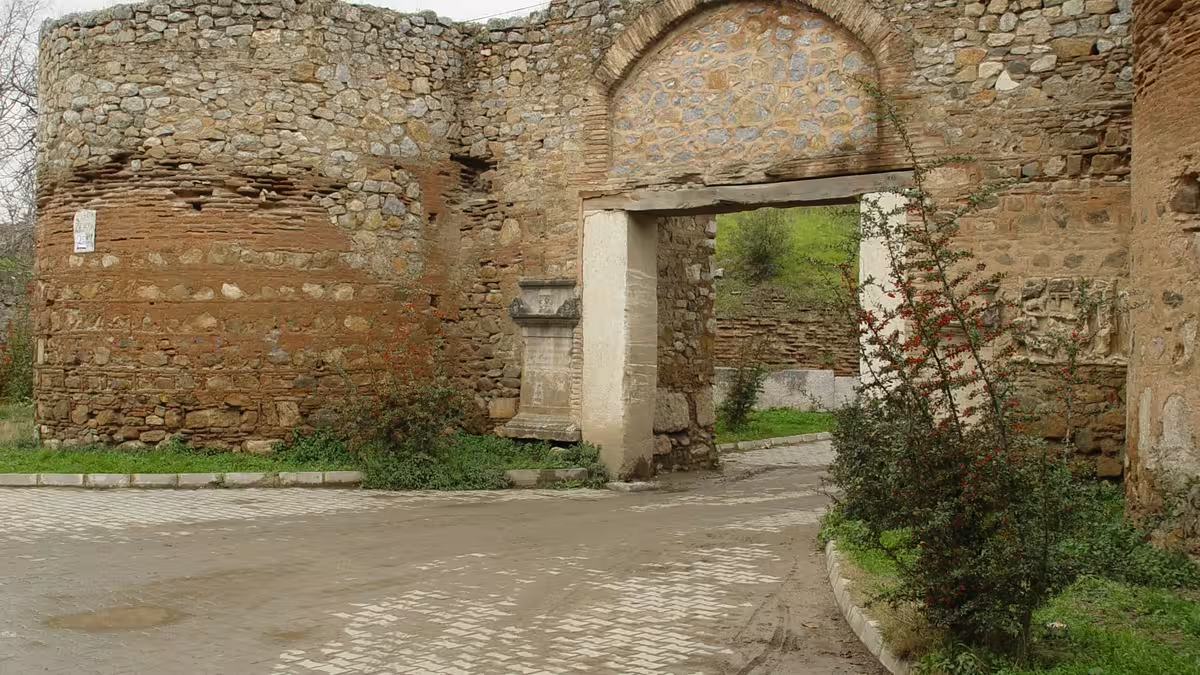
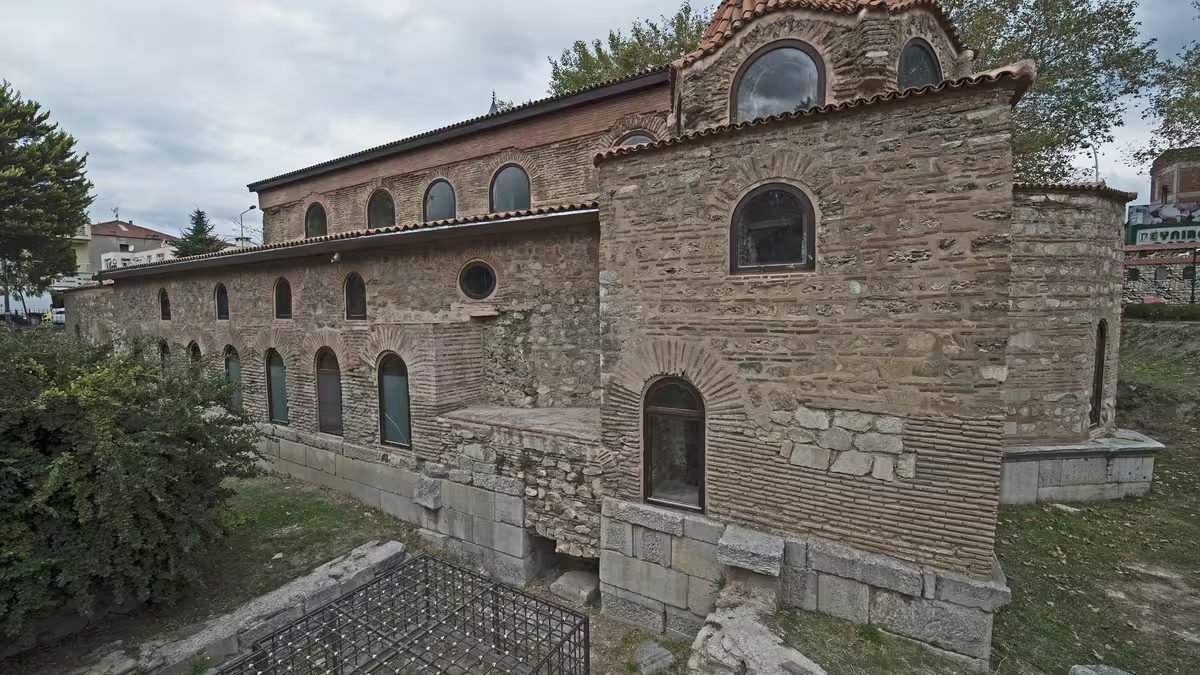
The basilica itself came to light in 2014, when an aerial photograph showed the outline of a church under the shallow water near the shore.3 Excavation began in 2015 under Professor Mustafa Şahin of Bursa Uludağ University, with permission from the Ministry of Culture and Tourism. In the 2026 season the team opened a trench east of the basilica’s prothesis, the room where the sacred vessels were kept, and found its floor paving running on beyond the later walls, together with wall sections and a column base. Şahin identifies these as the Church of Saint Neophytos, destroyed in the earthquake of 368, and the basilica above it as the Church of the Holy Fathers, built after 380 in memory of the bishops of the council. Coins of the emperors Valens and Valentinian from graves before its sanctuary date the later church to about 380.4 Researchers from the University of Calabria and the Magna Graecia University of Catanzaro joined the work this season.5
The same trench produced a gold ring decorated with a palm tree and a sword, of a type known from the Umayyad and Abbasid periods. Şahin connects it with the Umayyad siege of Nicaea in 729, which failed after six months, though the Umayyad commander is recorded as having entered the Church of the Holy Fathers.6
A church or a palace hall?
Şahin rests his identification partly on Eusebius of Caesarea, a bishop present at the council, who described the meeting place as a small house of worship.7 The same Eusebius, in his account of the council’s formal session, places the assembled bishops in the central hall of the imperial palace, where Constantine entered to address them.8 The older Catholic reference literature reconciles the two by holding that the council sat both in the principal church and in the palace hall.9 The new evidence confirms that a smaller and earlier church stood beneath the Church of the Holy Fathers; whether every session of 325 met inside it is a question the written sources leave open. Şahin himself now describes the location of the Church of the Holy Fathers as settled.10
Why the council met
The dispute began in Alexandria. Arius, a presbyter of that city, taught that the Son of God had a beginning and was created by the Father. His bishop, Alexander, condemned him at a synod of more than a hundred bishops from Egypt and Libya in about 320, but Arius kept his church and his following.11 Constantine, sole emperor from 324, called a general council to settle the question, chose Nicaea in Bithynia, and put the imperial post at the bishops’ disposal so that they could travel to it.12 The council opened on 19 June 325. Eusebius counted more than 250 bishops; the figure of 318, which became traditional, comes from Hilary of Poitiers.13
What was decided
The council issued a creed. It confessed one God the Father and one Lord Jesus Christ, the Son of God, and added the words that decided the dispute: that the Son is from the substance of the Father, and “begotten not made, consubstantial with the Father.” The Greek word for consubstantial, homoousios, meaning of one substance, entered Christian doctrine at Nicaea. The creed closed with anathemas against anyone who said that there was once a time when the Son did not exist, that he came from nothing, or that he was of another substance than the Father.13 The council’s letter to the church of Alexandria reports that Arius and two Egyptian bishops who refused to sign shared his condemnation.13 Beyond the creed, the council settled that Easter should be kept on the same day throughout the church, and issued twenty canons on church order.13
Nicaea and the five sees
Two of those canons began the ranking of the great churches. The sixth confirmed the long-standing authority of the bishop of Alexandria over Egypt, Libya and Pentapolis, likening it to that of the bishop of Rome, and preserved the privileges of Antioch; the seventh gave special honour to the bishop of Aelia, the Roman name for Jerusalem.13 Constantinople, founded as the new imperial capital in 330, was placed second after Rome by the Council of Constantinople in 381 and again at Chalcedon in 451.14 The emperor Justinian gave the arrangement its classic form in his legislation in the sixth century, and the Council in Trullo in 692 ranked the five patriarchal sees as Rome, Constantinople, Alexandria, Antioch and Jerusalem, the order later called the pentarchy. Nicaea itself was never one of the five: it is the city where their ranking began.15
The pentarchy did not last long in practice. In the seventh century, within a century of Justinian, Alexandria, Antioch and Jerusalem came under Muslim rule, and the patriarch of Constantinople was left as the only effective head of Eastern Christianity.15 In 2025 Pope Leo XIV came to İznik for the 1,700th anniversary of the council.16
Earthquake, conquest and the lake
The earthquake of 368 that destroyed the Church of Saint Neophytos was not the last to strike Nicaea. Another, in 740, brought down the Church of the Holy Fathers, and its ruins sank into the lake, where they lay forgotten for more than a thousand years.17 An earthquake in the eleventh century damaged the Hagia Sophia in which the Second Council of Nicaea had met in 787, and the church of the Dormition, the Koimesis, was destroyed in 1065.18
Conquest followed. The Seljuks took Nicaea in 1081, made it their capital and gave it the name İznik; the Byzantines recovered it in 1097. After the crusaders seized Constantinople in 1204, Nicaea became the heart of the Byzantine successor state, the Empire of Nicaea, with a palace for the patriarch, until Constantinople was retaken in 1261. In 1331 the Ottomans took the city and made it for a short time their capital. They converted its Hagia Sophia into the Orhan Mosque and built there some of the earliest Ottoman mosques, madrasas and soup kitchens, and in the sixteenth and seventeenth centuries İznik tiles decorated mosques and palaces throughout the empire. The city suffered again during the Turkish War of Independence, when the Koimesis church was badly damaged.19
The lake has since given back what the earthquake took. When the basilica was found in 2014 it lay about fifty metres offshore under two metres of water; the lake began to retreat in 2020, and by 2025 the whole building stood on dry land.20
The Qur’anic answer
Three centuries after Nicaea declared the Son of one substance with the Father, the Qur’an addressed the claim at its root. In the chapter named for Mary it rejects the idea that God has walad (وَلَد, offspring) in terms of cosmic gravity:
وَقَالُوا۟ ٱتَّخَذَ ٱلرَّحْمَـٰنُ وَلَدًا ٨٨
They say, “The Most Compassionate has offspring.”
لَّقَدْ جِئْتُمْ شَيْـًٔا إِدًّا ٨٩
You have certainly made an outrageous claim,
تَكَادُ ٱلسَّمَـٰوَٰتُ يَتَفَطَّرْنَ مِنْهُ وَتَنشَقُّ ٱلْأَرْضُ وَتَخِرُّ ٱلْجِبَالُ هَدًّا ٩٠
by which the heavens are about to burst, the earth to split apart, and the mountains to crumble to pieces
أَن دَعَوْا۟ لِلرَّحْمَـٰنِ وَلَدًا ٩١
in protest of attributing children to the Most Compassionate.
Qur’an 19:88-9121
The history of Nicaea gives that language an earthly echo. The verses speak of the earth about to split apart and the mountains about to crumble at the claim; the ground beneath the city where the claim was first written into a creed split again and again. The earthquake of 368 destroyed the church in which the council is believed to have met, and the earthquake of 740 brought down the church raised over it in the bishops’ memory and sent its ruins beneath the lake. The Hagia Sophia in which the second council of Nicaea met in 787 became, under Orhan, a mosque, and serves as one today.
The Qur’an names no city, and a historian cannot read the earthquakes of Bithynia as a verdict. A reader who sets the verses beside the history of Nicaea will still notice the correspondence: the doctrine the verses reject was defined in a city whose earth split, whose church fell and sank, and whose great church now serves the worship of the one God.
Elsewhere the Qur’an calls Jesus the Messiah, a messenger of God and His word conveyed to Mary, and tells Christians not to say “three”; its short chapter on God’s oneness states that He neither begets nor was begotten.22 The council at Nicaea and the Qur’an thus answer the same question about Jesus, and answer it in opposite ways: the one by declaring him of the same substance as God, the other by declaring that God has no offspring at all. See Jesus across the traditions and Christianity.
Further reading: Jesus across the traditions, Paul and Peter: two missions in the early church, The Abrahamic family tree and what the traditions share, The five great sees of the early church, Hagia Sophia: cathedral, mosque, museum and mosque again.
Notes
- “Lost Church of First Council of Nicaea emerges beneath Iznik Basilica,” Türkiye Today, 10 July 2026. ↩
- “Archaeologists find possible remains of Church that hosted the First Council of Nicaea,” HeritageDaily, 10 July 2026; “Archaeologists unearth secret church tied to Council of Nicaea,” Fox News Digital, 10 August 2026. ↩
- “Early Christian Church That May Have Hosted First Council of Nicaea Found in Turkey,” Greek Reporter, 11 August 2026. ↩
- Türkiye Today, op. cit., reporting Mustafa Şahin to Anadolu Agency. ↩
- HeritageDaily, op. cit. ↩
- Türkiye Today, op. cit. ↩
- Ibid., quoting Şahin. ↩
- Eusebius of Caesarea, Life of Constantine 3.10, trans. E. C. Richardson, Nicene and Post-Nicene Fathers, second series, vol. 1 (New York, 1890). ↩
- “First Council of Nicaea,” The Catholic Encyclopedia, vol. 11 (New York: Robert Appleton Company, 1911). ↩
- Fox News Digital, op. cit., quoting Şahin to Anadolu Agency. ↩
- The Catholic Encyclopedia, op. cit. ↩
- Eusebius, op. cit., 3.6. ↩
- Norman P. Tanner, ed., Decrees of the Ecumenical Councils, vol. 1 (London: Sheed & Ward, 1990), First Council of Nicaea: introduction, profession of faith, canons 6-7 and the synodal letter to the Egyptians, as reproduced by Papal Encyclicals Online. ↩
- “The Pentarchy and the Moscow Patriarchate,” OrthoChristian.com, on canon 3 of Constantinople I and canon 28 of Chalcedon. ↩
- “Pentarchy,” Encyclopaedia Britannica. ↩
- Türkiye Today, op. cit. ↩
- “Pope Leo XIV’s visit rekindles debate: Did First Council of Nicaea meet at Sunken Basilica?,” Türkiye Today, 29 January 2026; UNESCO World Heritage Centre, “İznik,” Tentative List entry 5900 (submitted 2014). ↩
- UNESCO, op. cit. ↩
- Ibid. ↩
- “Ancient Roman Basilica Emerges From Lake in Turkey After 700 Years Underwater,” Greek Reporter, 25 November 2025, quoting Mustafa Şahin. ↩
- Qur’an 19:88-91, trans. Mustafa Khattab, The Clear Quran. ↩
- Qur’an 4:171; 112:1-4. ↩