
The Qur’an names the Sabians, al-Ṣābiʾūn (الصابئون, the Sabians), three times, beside the Jews, the Christians and, once, the Magians.1 Who they were has been argued over since the first commentators. Western scholarship has mostly concluded that the communities later known by the name, the star-venerating Harranians of northern Mesopotamia and the Mandaeans of southern Iraq, have little claim to it; Arabic scholarship, classical and modern, has tended to accept them.2 A 2023 thesis from the American University in Cairo by Maurice Hines takes the classical Muslim authors at their word and reads them as evidence in their own right.3
Ibn al-Nadīm and the Harranians
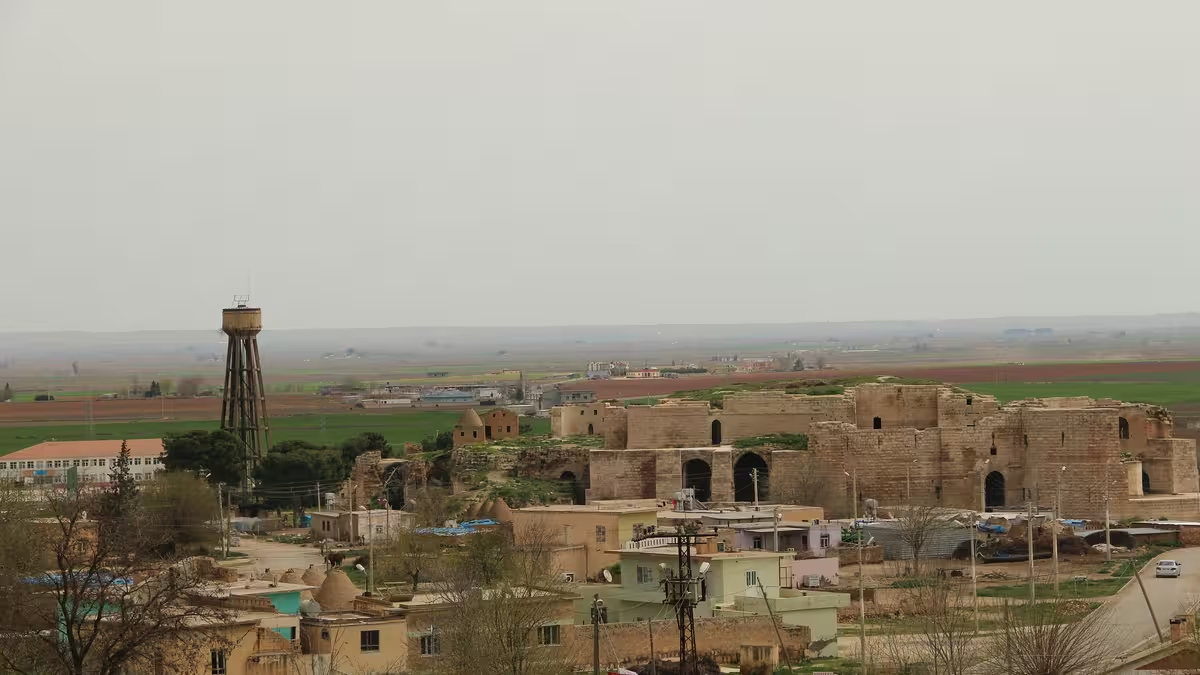
Ibn al-Nadīm, a Baghdad bookseller and copyist, completed his catalogue of the books in circulation in 377/987, at the height of the Abbasid translation movement.4 His account of the Harranians gives two pictures. In one they pray three times a day after ablution, fast, abstain from pork and keep purity rules close to those of Islam; in the other, their monthly rites to the planets resemble the mystery cults of the Greek world.5
He also preserves the best-known story about them. The caliph al-Maʾmūn, passing through Harran on campaign against Byzantium, asked what kind of protected people they were and gave them until his return to change their religion. A learned man among them advised them to call themselves Sabians, a name the Qur’an already recognised.6 The story survives in Ibn al-Nadīm alone, and Hines doubts it happened as told; Harranian scholars were nonetheless calling themselves Sabians by the late ninth century.7 Jurists from Harran itself later ruled that Muslims could not marry Harranian women, since the Harranians were not People of the Book. Muslim readers of the time, Hines concludes, did not take the Harranians for the Sabians of the Qur’an.8
Ṣāʿid al-Andalusī and the first religion
In the eleventh century the Toledo judge Ṣāʿid al-Andalusī wrote a history of the sciences that traces them to Sabian origins, treating Sabianism as the religion of the ancient nations before its decline.9 He described the pre-Islamic Arabs as monotheists who used idols to seek nearness to the one God. Hines explains the claim by that framework: if the first religion of every nation was monotheistic, its later idols were a corruption of it.10
Al-Shahrastānī: Abraham against the stars
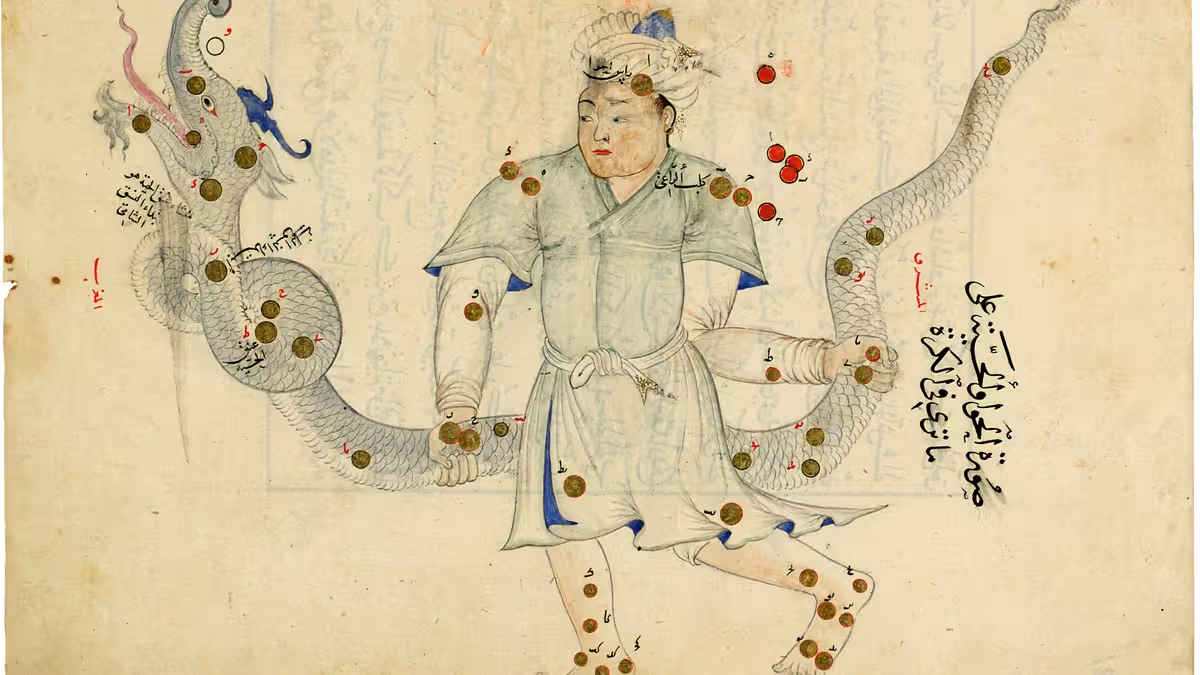
The fullest framework comes from al-Shahrastānī, writing in Khurasan in the twelfth century. He sets the Sabians against the ḥunafāʾ (الحنفاء, the pure monotheists). The Sabians approached the transcendent God through intermediaries: spiritual beings, the planets that house them, and the idols made to stand in for the planets when they could not be seen. The ḥunafāʾ held that a human prophet could stand above the angels and the stars.11
Al-Shahrastānī then reads the Qur’an’s account of Abraham as a sustained argument against both forms of that worship. Abraham first refuted idol worship in words, then by demonstration, breaking the idols and leaving the largest standing. He then turned to the worshippers of the heavenly bodies, and his proof against them was that each star, the moon and the sun set and faded.12 Read this way, Abraham’s contemplation of the heavens in the sixth chapter of the Qur’an is a disputation with star worshippers, conducted on their own ground.13
A Mandaean answer
The Mandaeans, the one community still called Sabians in Iraq, tell the same history from the other side. Their legend makes Abraham a Mandaean priest, Bahram, who developed a sore and was circumcised. Since the Mandaean priesthood admits no maimed body, he left the community for the desert, and his later strength came from Yurba, a power of darkness.14 Al-Bīrūnī reported a version of the story about the Harranians, taken from a Christian author who wrote against them.15 E. S. Drower, who recorded the Mandaean legend, judged it a story invented to explain circumcision.16 The Mandaean legend and al-Shahrastānī’s reading of the Qur’an agree on one point: Abraham broke with a star-venerating priesthood, and those who followed him and those who stayed became two communities, the ḥunafāʾ and the Sabians.17
The case for the classical authors
Hines’s central claim is that the classical scholars understood the Sabians better than their modern critics allow. Had the Harranians chosen a Qur’anic name at random, he asks, why did they settle on Sabians, when Jews, Christians and Magians were equally available? The choice suggests that the name already carried recognisable marks, above all a devotion to the stars and to the angels thought to govern them.18 He reads the classical sources as describing an ancient theosophical religion that later prophets answered in turn, and ties this to the Qur’an’s statement that mankind was once a single community to which God then sent prophets.19
The thesis describes its own claims as bold, and it draws on modern esoteric writers alongside academic sources. The prevailing academic view, represented by Chwolsohn, de Blois and van Bladel, still separates the historical Harranians and Mandaeans from the Sabians the Qur’an names.20 The classical texts Hines gathers keep their value either way: they show Muslim scholars working from the Qur’an’s own account of Abraham to understand a religion they could still observe.
Further reading: The Sabians of the Qur’an, Who was Abraham?
Notes
- Qur’an 2:62; 5:69; 22:17. ↩
- Maurice Hines, Interpretatio Islamica and the Unraveling of the Ancient Sabian Mysteries (MA thesis, American University in Cairo, 2023), p. 8. ↩
- Ibid., pp. 5, 21-22. ↩
- Ibid., pp. 26-27. ↩
- Ibid., pp. 48-50, citing Ibn al-Nadīm, al-Fihrist, pp. 442-448. ↩
- Ibid., pp. 50-51, citing al-Fihrist, pp. 445-446. ↩
- Ibid., p. 50, n. 69. ↩
- Ibid., pp. 51-52. ↩
- Ibid., p. 53. ↩
- Ibid., p. 56. ↩
- Ibid., pp. 63-64, citing al-Shahrastānī, al-Milal wa al-Niḥal, vol. 2, pp. 291, 352-353. ↩
- Ibid., p. 64; Qur’an 6:74; 19:42; 21:63-65; 37:95-96. ↩
- Qur’an 6:75-79; Hines, op. cit., p. 77. ↩
- E. S. Drower, The Mandaeans of Iraq and Iran (Oxford: Clarendon Press, 1937), pp. 265-266, 268. ↩
- Ibid., pp. 268-269. ↩
- Ibid., p. 269. ↩
- Hines, op. cit., p. 76. ↩
- Ibid., p. 89. ↩
- Ibid., pp. 68-69; Qur’an 2:213. ↩
- Ibid., pp. 5, 17-18. ↩