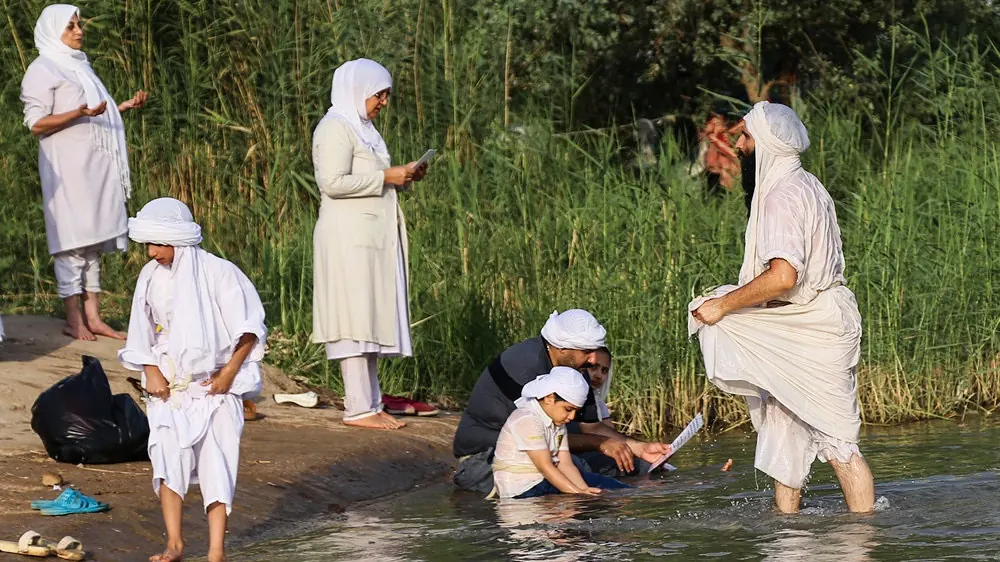
Baptism is the central act of Mandaean worship. Christians are baptised once; Mandaeans return to the water again and again, on Sundays and feast days, after childbirth and at marriage. The rite is called maṣbuta (baptism), and it needs running water.

The water
Mandaeans call the water of baptism yardna, Jordan, and the earthly stream stands for a heavenly one. Most scholars take the word from the river itself, although E. S. Drower doubted the connection. Each person enters the water and is baptised individually; there is no collective rite.1 Still water will not serve. The rite is held at the pool of a mandi, the sacred enclosure, or in the river itself: the first baptism Drower witnessed, of a woman after childbirth, took place in the river at Amarah on a Sunday.2
Before the rite
The priest prepares himself first. Standing barefoot in his white ritual dress, the rasta, he faces the North Star and recites the rahmi, the prayers of the day.3 He twists fresh myrtle into two small wreaths, one for his own head and one for his staff; each candidate receives a wreath of the same kind and carries it on the little finger of the right hand until after the immersion.4
In the water
The candidate goes down into the yardna and submerges three times, and in the fuller form of the rite the priest, standing before the candidate, dips him under three times more. Immediately afterwards the priest signs the forehead three times, drawing his finger from the right ear to the left, and pronounces the baptismal formula over the person by name: “thou art signed with the sign of Life”.5 The candidate drinks from the water three times, and priest and candidate clasp hands in the kushta, the ritual handclasp. The priest then places the myrtle wreath beneath the candidate’s headdress, the leaves falling over the left temple.6
On the bank
The baptised wait on the bank, facing north. When a small group has been immersed, the priest comes out of the water and signs each forehead three times with a paste of sesame. Each person washes the bared right arm in the pool, and the priest gives each a fragment of the sacramental bread, the pihtha.7
Baptism among the traditions
Immersion in water runs through all four traditions. Jewish law requires immersion in a mikveh, a ritual pool, for purity and for conversion. Christian baptism, received once, marks entry into the Church. Islam prescribes wuḍūʾ (وضوء, ablution) before prayer and ghusl (غسل, full washing) after major impurity. Mandaeism alone makes a repeated baptism in running water, performed by a priest, the heart of its worship. See John the Baptist in four traditions and Mandaeism.
Further reading: Prayer across the Abrahamic traditions and The Sabians of the Qur’an.

Notes
- Eric Segelberg, Maṣbūtā: Studies in the Ritual of the Mandaean Baptism (Uppsala: Almqvist & Wiksells, 1958), p. 38. ↩
- E. S. Drower, The Mandaeans of Iraq and Iran (Oxford: Clarendon Press, 1937), p. 109. ↩
- Ibid., p. 110. ↩
- Ibid., pp. 35-36. ↩
- Eric Segelberg, Maṣbūtā: Studies in the Ritual of the Mandaean Baptism (Uppsala: Almqvist & Wiksells, 1958), p. 53. ↩
- E. S. Drower, The Mandaeans of Iraq and Iran (Oxford: Clarendon Press, 1937), p. 36. ↩
- Ibid., pp. 115-116. ↩