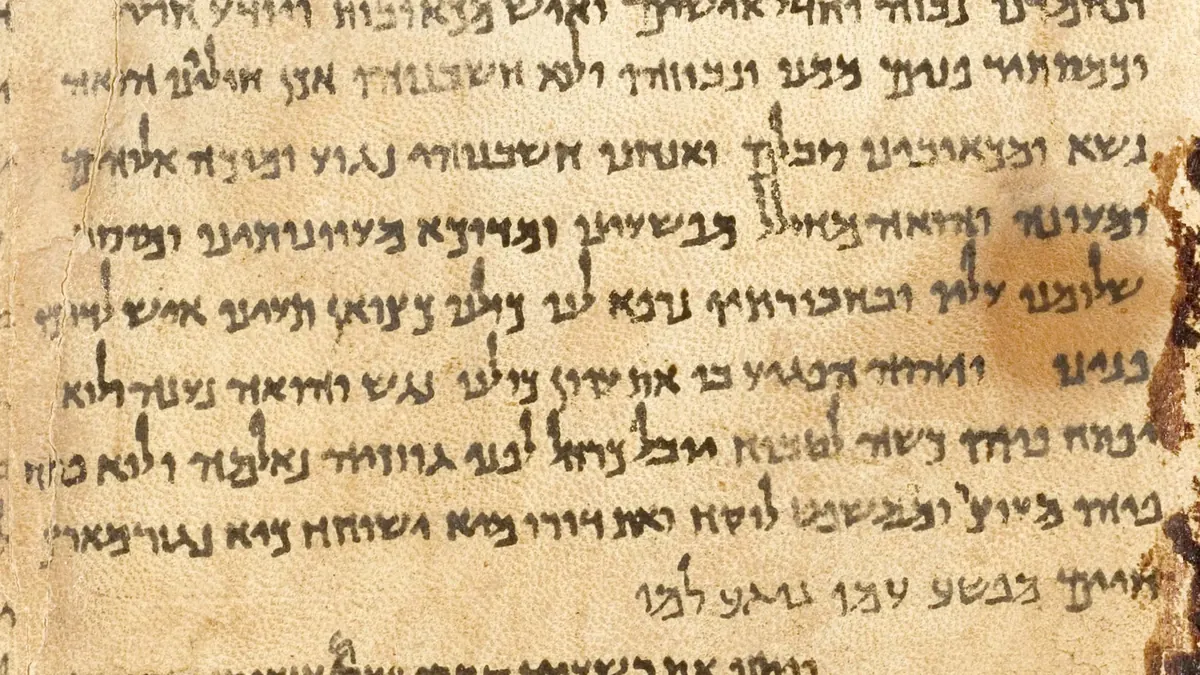
How a scripture reaches the present matters as much as what it says. Judaism, Christianity and Islam each developed a distinct answer to the problem of transmission across centuries and, in the case of the Qur’an, across a period when writing itself was far from universal.

The Hebrew Bible
The Dead Sea Scrolls, found near Qumran from 1947 onwards, include copies of nearly every book of the Hebrew Bible from the third century BCE to the first century CE. Compared with the medieval Masoretic Text codified centuries later, they show substantial agreement in most books alongside real variation in others, evidence of a text that stabilised gradually rather than all at once.1
The New Testament
The New Testament survives in thousands of Greek manuscripts, far more than any other ancient text, but no two of the earliest ones agree in every particular; textual critics work by comparing this manuscript tradition to reconstruct the earliest recoverable readings, a discipline as old as the printed Greek New Testament itself.2
The Qur’an
Islamic tradition holds that the Qur’an was both memorised and written down during Muhammad’s lifetime, and that the caliph ʿUthmān, within about twenty years of his death, had a single standard written text prepared and copies sent to the garrison cities, with other versions destroyed.3 Two manuscripts discussed elsewhere on this site bear on the claim. The Birmingham leaves, radiocarbon-dated to within the range of Muhammad’s own lifetime, match the standard text closely.4 The Sana’a palimpsest is more complicated: its later, upper layer also matches the standard text, but an earlier, erased lower layer, recovered by ultraviolet imaging, differs from it in wording and in the order of its chapters, and its script predates the reforms that later fixed the reading of the Arabic consonants.5 Specialists read the lower text as a variant version in circulation before ʿUthmān’s standardisation rather than as evidence against the tradition’s account of a subsequent, deliberate unification of the text.6
Oral transmission
Alongside the manuscripts, Islamic scholarship places heavy weight on the chain of memorisation: reciters (ḥuffāẓ) who learned the whole text by heart from a teacher who had done the same, a chain (isnād) tradition also central to the transmission of hadith. A text is called mutawātir, or continuously attested, when so many independent chains converge on the same reading that collusion in error is considered practically impossible.7 Judaism developed a comparable safeguard for its own scripture in the Masoretes’ meticulous counting of letters and words to guard against a copyist’s slip.8
What the comparison shows
Each tradition met the problem of transmission with the tools available to it: Judaism through Masoretic precision, Christianity through the sheer number of surviving copies subjected to critical comparison, and Islam through a written text stabilised early and reinforced by memorisation. None of the three claims an autograph, the author’s own original copy, has survived; each instead offers a documented case for how confidently its later text can be traced back toward its origin. See Understanding the Bible and the Qur’an in historical context.
Further reading: Understanding the Bible and the Qur’an in historical context, The Sabians of the Qur’an and The Cairo Genizah.

Notes
- Emanuel Tov, Textual Criticism of the Hebrew Bible, 3rd rev. ed. (Minneapolis: Fortress Press, 2012), on the Qumran biblical scrolls and the proto-Masoretic tradition. ↩
- Bruce M. Metzger and Bart D. Ehrman, The Text of the New Testament: Its Transmission, Corruption, and Restoration, 4th ed. (Oxford: Oxford University Press, 2005). ↩
- Ṣaḥīḥ al-Bukhārī, Book of the Merits of the Qur’an, on Zayd ibn Thābit’s compilation under Abū Bakr and ʿUthmān’s standardisation and dispatch of copies. ↩
- University of Birmingham, “Birmingham Qur’an manuscript dated among the oldest in the world,” press release, 22 July 2015. ↩
- Behnam Sadeghi and Uwe Bergmann, “The Codex of a Companion of the Prophet and the Qur’ān of the Prophet,” Arabica 57 (2010): 343-436; Asma Hilali, The Sana’a Palimpsest: The Transmission of the Qur’an in the First Centuries AH (Oxford: Oxford University Press, 2017). ↩
- Nicolai Sinai, “Beyond the Cairo Edition: On the Study of Early Quranic Codices,” Journal of the American Oriental Society 140, no. 1 (2020): 189-192, reviewing Hilali’s edition and the codex’s relation to the standard text. ↩
- Ibn al-Jazarī, al-Nashr fī al-Qirāʾāt al-ʿAshr, on the conditions for a mutawātir reading. ↩
- Tov, Textual Criticism of the Hebrew Bible, on the Masoretic apparatus and its scribal safeguards. ↩