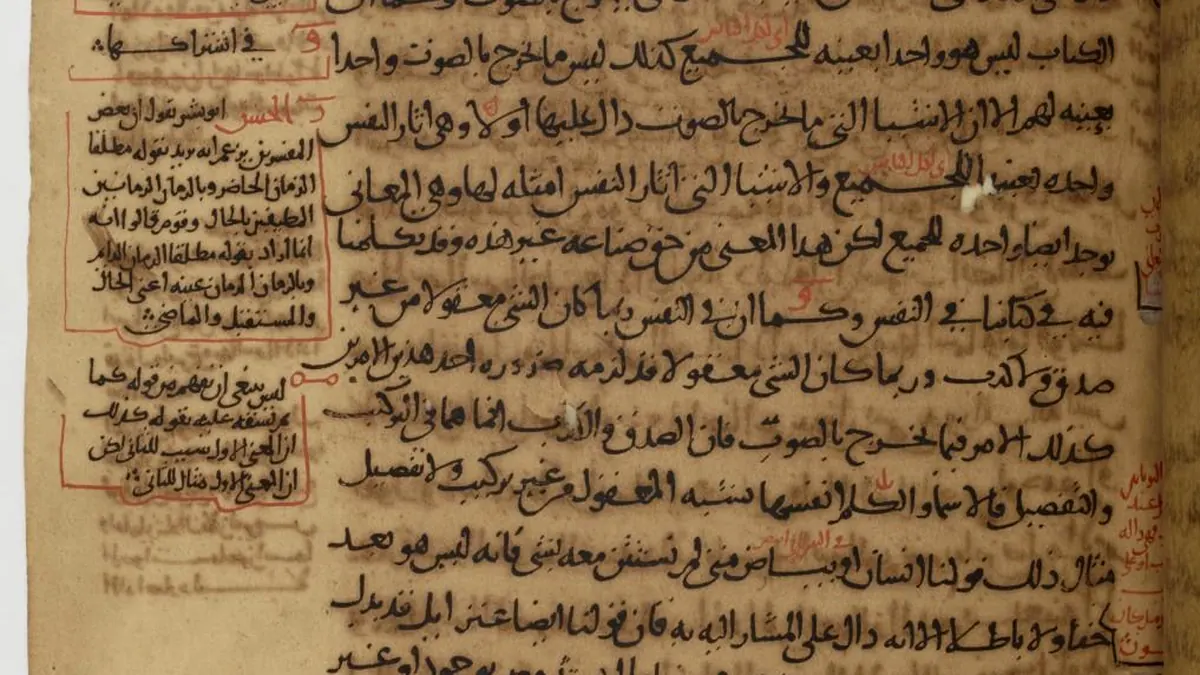
Faith and reason in medieval thought touches al-Ghazali and Ibn Rushd in passing; their dispute deserves its own telling, since it set the terms for how Islamic and, later, Christian scholasticism would argue about the proper limits of philosophy.

Al-Ghazali against the philosophers
Abū Ḥāmid al-Ghazālī (d. 1111), a jurist and theologian trained in the Ashʿarī school, wrote The Incoherence of the Philosophers to show that the Aristotelian metaphysics of Ibn Sīnā (Avicenna) and al-Fārābī could not deliver the certainty its practitioners claimed.1 He first set out their positions fairly, in a companion work, before attacking them on twenty points, three of which he judged to amount to unbelief: the philosophers’ denial of bodily resurrection, their claim that God knows only universals and not particulars, and their doctrine of the world’s eternity.2 His argument rested on occasionalism, the view that no created cause necessarily produces its effect; fire does not burn cotton by its own nature, but only because God customarily wills it so, and God could will otherwise.3
Ibn Rushd’s reply
Ibn Rushd (Averroes, d. 1198), a judge and physician of Córdoba and the most influential commentator on Aristotle in either the Islamic or the Latin world, replied decades later with The Incoherence of the Incoherence, defending the philosophers point by point and arguing that al-Ghazālī had misunderstood or misrepresented their positions.4 In a separate work, The Decisive Treatise, he argued that philosophy and revealed law could not truly conflict, since both were paths to the same truth, and that apparent conflicts called for allegorical interpretation of scripture rather than the abandonment of demonstrative reasoning.5
Who prevailed where
In the Islamic world al-Ghazālī’s side of the argument proved the more lasting: Ashʿarī theology and Sufi devotion remained dominant, and the school of philosophy Ibn Rushd defended found few successors after him among Muslim scholars.6 His influence travelled instead to Latin Europe, where his commentaries on Aristotle, translated into Latin, earned him the title “the Commentator” and shaped scholastic philosophy for centuries, Thomas Aquinas among those who engaged closely with his work.7 See Faith and reason in medieval Jewish, Christian and Muslim thought.
Further reading: Faith and reason in medieval Jewish, Christian and Muslim thought and How the Abrahamic religions understand monotheism.

Notes
- Al-Ghazālī, Tahāfut al-Falāsifa (The Incoherence of the Philosophers), trans. Michael E. Marmura, 2nd ed. (Provo: Brigham Young University Press, 2000), Introduction. ↩
- Al-Ghazālī, Tahāfut al-Falāsifa, Discussions 13, 16 and 20 on divine knowledge, bodily resurrection and the eternity of the world. ↩
- Al-Ghazālī, Tahāfut al-Falāsifa, Discussion 17, the celebrated example of fire and cotton. ↩
- Ibn Rushd, Tahāfut al-Tahāfut (The Incoherence of the Incoherence), trans. Simon van den Bergh (London: Luzac, 1954), Introduction. ↩
- Ibn Rushd, Faṣl al-Maqāl (The Decisive Treatise), trans. Charles E. Butterworth (Provo: Brigham Young University Press, 2001). ↩
- Majid Fakhry, A History of Islamic Philosophy, 3rd ed. (New York: Columbia University Press, 2004), on the decline of the falsafa tradition after Ibn Rushd. ↩
- Fakhry, A History of Islamic Philosophy, on the Latin reception of Ibn Rushd as “the Commentator.” ↩