
Among the figures the Qur’an places in Pharaoh’s court, none has drawn sharper criticism than Haman. Named six times, he is the official Pharaoh orders to build a tower reaching toward the heavens.1 Western Orientalists have long pointed to a difficulty: a Haman appears in the Bible too, centuries later and in a different empire.
The objection
The Bible’s Haman is a Persian official at the court of Ahasuerus (identified with Xerxes I), who plots the destruction of the Jews in the Book of Esther, set roughly a thousand years after Moses.2 Since the Qur’an places a Haman at Pharaoh’s side instead, a line of scholars from the seventeenth century onward concluded that Muhammad had confused the two settings. Theodor Nöldeke put it bluntly in his 1891 Encyclopædia Britannica article: “The most ignorant Jew could never have mistaken Haman… for the minister of the Pharaoh.”3 Similar verdicts came from Alphonse Mingana, Henri Lammens and Arthur Jeffery, and the point still appears in reference works: the second edition of the Encyclopaedia of Islam calls the placement of Haman at Pharaoh’s court “a still unexplained confusion.”4
Is the biblical source itself reliable?
The objection assumes the Book of Esther gives a historically dependable account of a real official named Haman. That assumption is not shared by the scholars who study Esther closely. Jon Levenson, of Harvard Divinity School, writes that “the historical problems with Esther are so massive as to persuade anyone… to doubt the veracity of the narrative.”5 Michael Fox, a specialist in Hebrew and Egyptian literature at the University of Wisconsin, catalogues the book’s implausibilities and concludes it gives “the impression of a writer recalling a vaguely remembered past.”6 Adele Berlin, an editor of the Jewish Study Bible, notes that a succession of twentieth-century commentators, writing between 1908 and 1997, each independently concluded the book is not historical.7 No source outside the Bible attests to a Haman, a Mordecai or a Jewish queen at the Persian court, and the wife of the historical Xerxes is known by a different name, Amestris.8 Whatever the Qur’an’s Haman is, he cannot straightforwardly be measured against a firmly established biblical figure, because Esther’s own Haman is not one.
Haman as a title, not a name
A different line of scholarship, running from Sher Mohammad Syed in 1980 through Abdurrahman Badawi and Muhammad Asad, has proposed that Haman in the Qur’an is not a personal name at all but an Arabized form of an Egyptian title.9 The Qur’an’s own usage offers a precedent: it calls Joseph’s ruler “the king” but calls Moses’ ruler “Pharaoh,” a title derived from the Egyptian per-aa, “the great house,” which came to denote the king himself only in the New Kingdom.10 The proposal is that Haman works the same way, echoing imn or amana, the Egyptian god Amun, whose name formed part of several priestly and administrative titles, from the ordinary wab-priest up to the ḥm-nṯr-tpy, the High Priest of Amun, and, in at least one inscription, an architect’s title as well.11 On this reading, the Qur’an’s Haman held the office of High Priest of Amun, a position that combined religious authority with charge of major construction, rather than being a specific individual’s given name.
A candidate: Bakenkhons
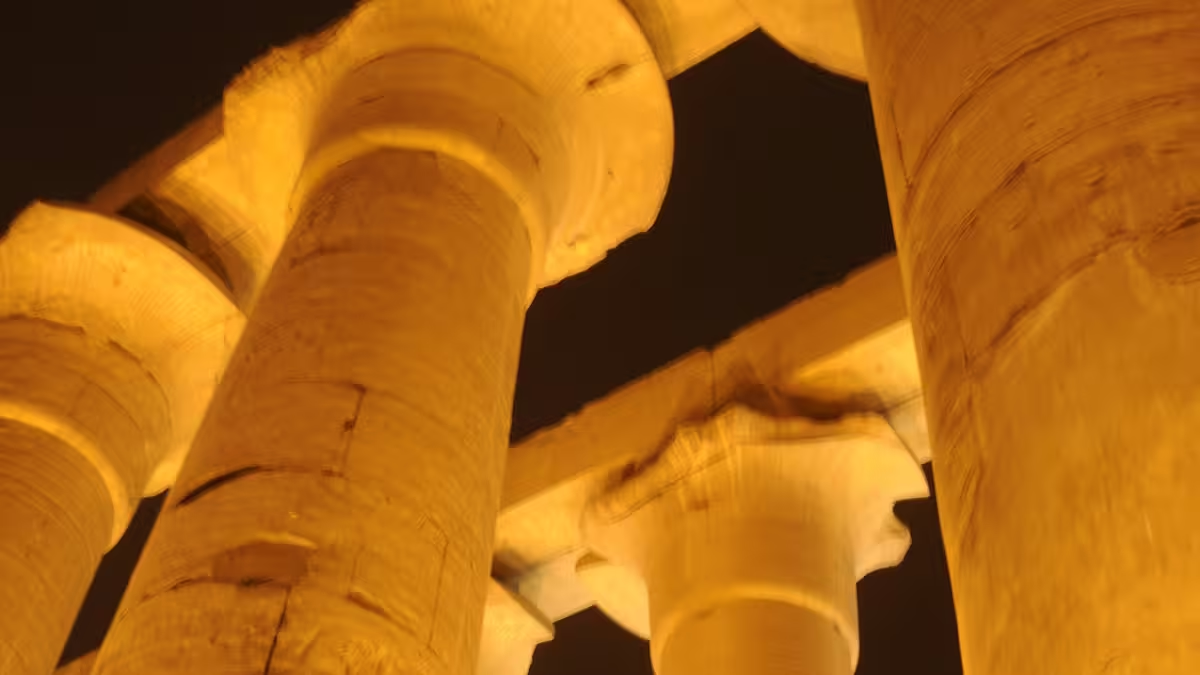
If the office is High Priest of Amun under Ramesses II, one holder fits unusually well: Bakenkhons, who served roughly seventy years in the priesthood and held the title “Chief of Works.” His own inscription, translated by the Egyptologist Kenneth Kitchen, records that he built a temple for Ramesses II and “erected obelisks in it, of granite stone, whose beauty reached up to the sky.”12 That phrase echoes the Qur’an’s account of Haman commanded to build so that Pharaoh might reach the heavens.13 One of the obelisks Bakenkhons raised still stands at the Luxor Temple, its partner now in the Place de la Concorde in Paris.
A correction along the way
Not every proposed link has held up. An earlier attempt connected Haman to an inscription reading ḥmn-ḥ on a door jamb naming an overseer of stonemasons; on review by the Egyptologist Jürgen Osing of the Freie Universität Berlin, the final ḥ proved to be part of the name rather than a separate word, and the office, that of a local overseer, sat too low in rank to fit the Qur’an’s Haman.14 The identification was withdrawn once the correction was made, which is worth stating plainly: a proposal built on inscriptional evidence has to give way when the inscription is read more carefully.
Where the question stands
The title theory is a minority position. Most specialists in Qur’anic studies, including Adam Silverstein in the most detailed modern treatment of the question, continue to hold that the Qur’an’s Haman descends literarily from the Book of Esther, by way of later commentary and legend rather than the Qur’anic text read alone.15 What the argument set out above establishes is narrower: the case against the Qur’an cannot rest on treating Esther’s Haman as settled history, since mainstream biblical scholarship does not treat him that way, and an Egyptian derivation of the name remains a live, evidenced alternative, tied to a specific office and a specific candidate, rather than a claim asserted without support. See The king and the Pharaoh.

Notes
- Qur’an 28:6, 8, 38; 29:39; 40:24, 36-37. ↩
- Esther 3:1-10:3. ↩
- Theodor Nöldeke, “The Koran,” Encyclopædia Britannica, 9th edn, vol. 16 (Edinburgh: Adam and Charles Black, 1891), p. 600. ↩
- “Hāmān,” Encyclopaedia of Islam, 2nd edn. ↩
- Jon D. Levenson, Esther: A Commentary (Louisville: Westminster John Knox Press, 1997), p. 26. ↩
- Michael V. Fox, Character and Ideology in the Book of Esther (Columbia: University of South Carolina Press, 1991), p. 131. ↩
- Adele Berlin, Esther (Philadelphia: Jewish Publication Society, 2001), pp. xvi-xvii. ↩
- The Universal Jewish Encyclopedia, s.v. “Esther.” ↩
- Sher Mohammad Syed, “Haman in the Light of the Qur’an,” Islamic Quarterly 24 (1980): 48-59; Muhammad Asad, The Message of the Qur’an (Gibraltar: Dar al-Andalus, 1980), note to Qur’an 28:6. ↩
- A. H. Johns, “Firʿawn,” Encyclopaedia of the Qur’an, vol. 2, citing the New Kingdom origin of the title “Pharaoh.” ↩
- Wörterbuch der Aegyptischen Sprache and Lexikon der Ägyptischen Götter und Götterbezeichnungen, entries under ḳmn and ʾimn, on the priestly and architectural titles compounded with the name of Amun. ↩
- K. A. Kitchen, Ramesside Inscriptions, Translated and Annotated: Translations, vol. III (Oxford: Blackwell, 1996-2000), the biographical inscription of Bakenkhons. ↩
- Qur’an 40:36-37. ↩
- Personal communication from Jürgen Osing, Ägyptologisches Seminar, Freie Universität Berlin, July 2009, on the door-jamb inscription of ḳmn-ḥ in the Kunsthistorisches Museum, Vienna. ↩
- A. Silverstein, “Hāmān’s Transition from Jāhiliyya to Islam,” Jerusalem Studies in Arabic and Islam 34 (2008, published 2009): 285-308. ↩