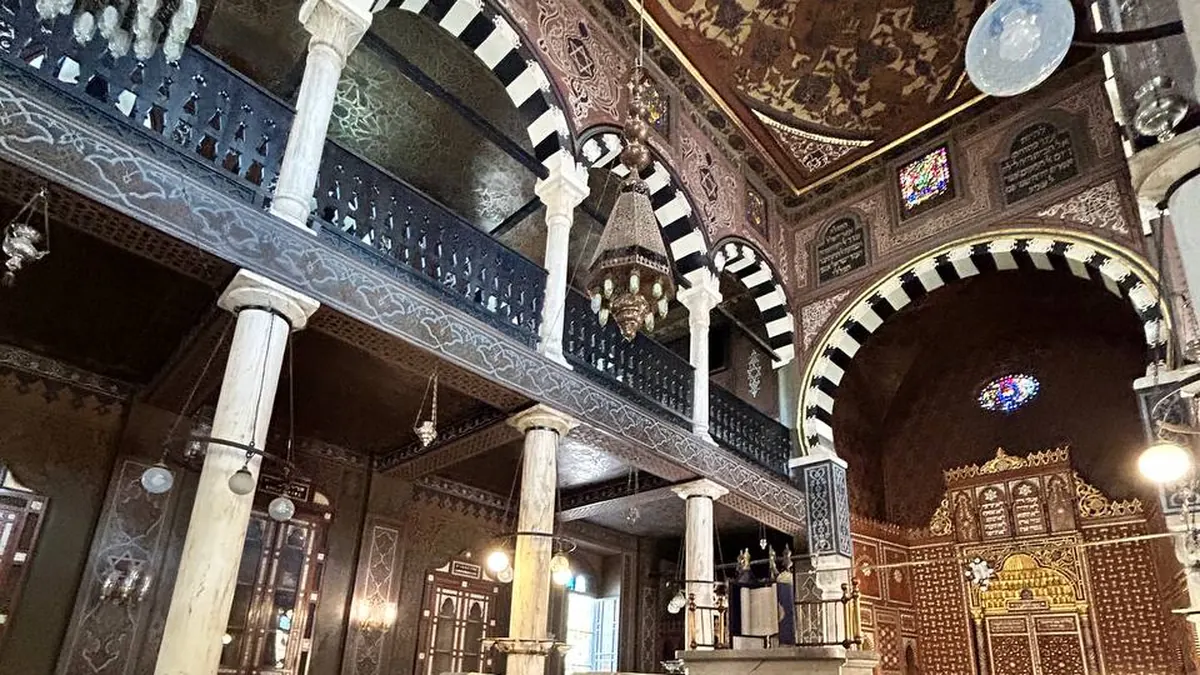
The Cairo Genizah is not a single discovery so much as a discipline’s refounding: a single storeroom that transformed how scholars study medieval Jewish life, and, along the way, produced one more piece of physical evidence for how a scripture is preserved.

What a genizah is
A genizah (גניזה, hiding place) is a storeroom where worn or damaged texts bearing the name of God are set aside rather than destroyed, since Jewish law forbids their disposal. The Ben Ezra Synagogue in Fustat, Old Cairo, kept one for close to a thousand years, from the sixth century CE into the nineteenth.1
The discovery
Fragments had trickled onto the antiquities market for decades before Solomon Schechter, a professor of rabbinic literature at Cambridge, examined a sample brought to him by two Scottish sisters in 1896 and recognised its importance. He travelled to Cairo, gained the community’s permission to remove what remained, and returned to Cambridge with roughly 193,000 fragments, now the Taylor-Schechter Genizah Collection.2 Further fragments, dispersed earlier or acquired later, are held at the Jewish Theological Seminary, the John Rylands Library in Manchester, and other collections; the whole find is now estimated at some 400,000 fragments.3
What it contains
Most of the material is mundane: letters, contracts, court records and shopping lists, written in Hebrew script across Hebrew, Judaeo-Arabic and Aramaic. It is precisely this ordinariness that makes the collection valuable, since it documents everyday medieval Jewish, and often Muslim and Christian, life in a way literary sources never do.4 Among the fragments are also biblical manuscripts and a Hebrew text of Ben Sira (Ecclesiasticus), previously known only in Greek translation, whose identification by Schechter first alerted him to the Genizah’s significance.5
Why it matters here
The Genizah’s biblical fragments sit alongside the Dead Sea Scrolls and the Aleppo and Leningrad Codices as part of the manuscript evidence for how the Hebrew Bible reached its present form, discussed further on the preservation and transmission article. Its far larger documentary record also preserves direct evidence of Jewish life under early Muslim rule in Egypt, the everyday counterpart to the more formal recognitions discussed on the Timeline. See The preservation and transmission of scripture and The Tanakh.
Further reading: The preservation and transmission of scripture and What archaeology tells us about the ancient Near East.

Notes
- S. D. Goitein, A Mediterranean Society, vol. 1 (Berkeley: University of California Press, 1967), 1-9. ↩
- Adina Hoffman and Peter Cole, Sacred Trash: The Lost and Found World of the Cairo Geniza (New York: Nextbook/Schocken, 2011), on Schechter’s 1896-97 expedition and the Taylor-Schechter Collection. ↩
- Rebecca J. W. Jefferson, "Deconstructing ‘The Cairo Genizah’: A Fresh Look at Genizah Manuscript Discoveries in Cairo before 1897," Journal of the American Oriental Society, on the collection’s dispersal and estimated total. ↩
- Goitein, A Mediterranean Society, vol. 1, Introduction, on the documentary character of the find. ↩
- Solomon Schechter, "A Fragment of the Original Text of Ecclesiasticus," The Expositor 55 (1896): 1-15. ↩